
Blog - AI in Society
The Era of "Shadow AI"
Why We Still Hide Our Smartest Partner - Generative AI.
By amedios editorial team in collaboration with our AI Partner
We’re All Using AI — But No One Wants to Admit It
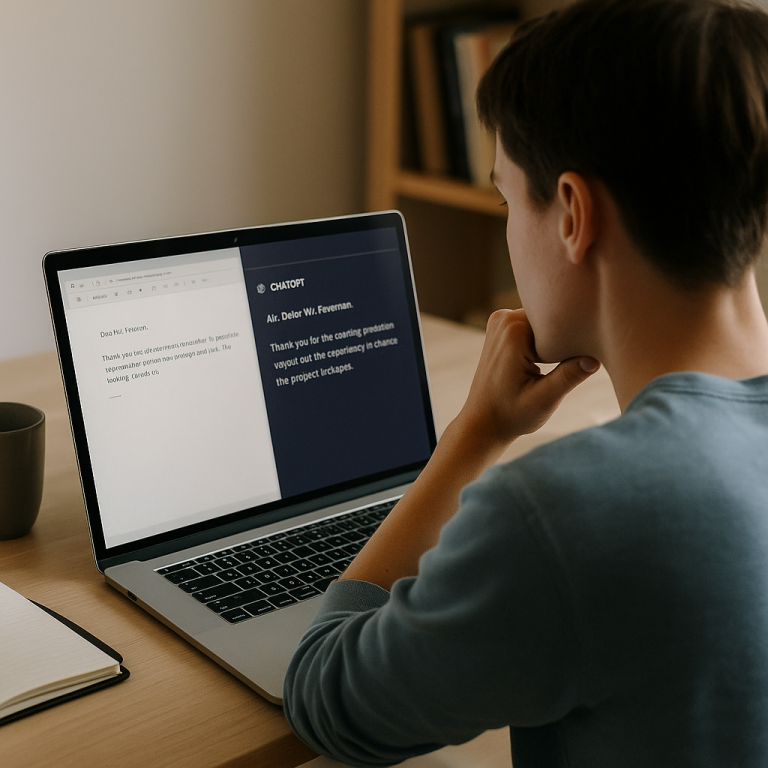
It’s late evening in an open-plan office. The fluorescent lights hum softly, and a marketing manager stares at her screen, exhausted. A client presentation is due at 9 a.m. — she opens ChatGPT, pastes the brief, and types: “Make this sound more professional and persuasive.”
Within seconds, the AI delivers a crisp new draft. She copies the key lines into her slides, closes the tab, and breathes out. Tomorrow, she’ll present it as her own work.
She isn’t lying. She’s surviving.
Across the world, this small, silent act repeats itself millions of times each day. Teachers, journalists, engineers, students, designers. They (we) all use AI to make their (our) jobs easier. Yet almost none of them (us) mention it.
We call this the Era of Shadow AI: a time when artificial intelligence has become a natural part of human productivity, but the culture around it hasn’t caught up. We embrace the help, but fear the judgment.
The paradox is that people use AI precisely to improve quality, creativity, and accuracy - and then hide it, as if improvement were a crime.
The Silent Partner We Pretend Isn’t There
There’s an unwritten social code in most workplaces: use AI if you must, but don’t let anyone see you doing it.You can polish your grammar, but not your ideas. You can automate your slides, but don’t tell your boss you did.
This quiet hypocrisy stems from an outdated idea of “authentic intelligence”. It is the ancient belief that true merit comes from struggle, not from skillful use of tools. But that’s not how human progress ever worked.
We didn’t shame mathematicians for using calculators or architects for using CAD software. Yet somehow, with AI, the rules changed. A teacher who corrects essays with an AI summarizer is considered lazy.
A lawyer who drafts a first version of a contract with an AI assistant feels she’s breaking an invisible rule. A student who uses AI to outline an essay worries about being accused of cheating, even if the ideas are genuinely theirs.
The result is a global double life: people use AI privately, then manually disguise its fingerprints - rephrasing sentences, changing synonyms, or inserting typos — to make it look “human.”
It’s an ironic waste of intelligence - both human and artificial.
When Secrecy Backfires
Sometimes, the shadows leak. In October 2025, a journalist at the leading German news magazine Spiegel.de published an article that ended with a forgotten AI line: “Would you like me to further optimize this text?” It was a harmless mistake - a digital breadcrumb - but within hours, screenshots spread online. Critics mocked him for “outsourcing” his work to a machine. What could have sparked a thoughtful debate about collaboration turned into a public shaming ritual.
The damage wasn’t technical; it was cultural.
Because the journalist didn’t have the space or standards to talk openly about his process, transparency became embarrassment. Similar incidents occur everywhere.
A university retracts an academic paper after realizing its summary was AI-generated. A PR agency posts a campaign slogan that accidentally mirrors another company’s tagline - simply a by-product of its model’s training data. A government office issues a press release written by AI, later found to contain outdated information.
In each case, the issue isn’t that AI was used. It’s that it was used blindly, without review, disclosure, or understanding.
The Hidden Cost of Shame
Secrecy creates more than bad optics. It stifles innovation.
- When employees fear admitting they used AI, they stop sharing effective workflows.
- When teachers punish any AI use, students never learn to evaluate outputs critically.
- When leaders equate automation with laziness, organizations lose the opportunity to scale intelligence rather than just labor.
In short, hiding AI doesn’t protect integrity. It prevents progress.
We’ve seen this before. When typewriters first entered classrooms, educators worried they’d “weaken handwriting.” When early spreadsheets appeared, accountants feared job loss. Each new tool caused anxiety before becoming invisible.
AI will follow the same path, but only if we bring it into the light.
At Amedios, we view this shift not as a technical adoption, but as a psychological transition.
It’s not about replacing effort; it’s about redefining what effort means in a world of amplified intelligence.
Why People Still Distrust AI
Part of the discomfort comes from uncertainty about how AI actually works. Large language models don’t “think”. They just predict. They generate sentences based on statistical likelihood, not understanding. That gap between sound and sense unnerves people.
We read fluent paragraphs and assume comprehension, but under the surface, there’s no awareness - only probability. This cognitive mismatch fuels skepticism: if the AI doesn’t truly understand, can its output be trusted?
The answer is: sometimes yes, sometimes no. This depends entirely on human oversight (the so-calles "human in the loop"). Without clear evaluation criteria, users swing between blind trust (“the AI must be right”) and total rejection (“you can’t trust any of it”).
Neither extreme is literacy. Both are superstition.
How to Judge AI Content - Lessons from Markup.ai
Charlotte Baxter-Read, Marketing Director at Markup.ai, tackled this gap in her article “Guide to Evaluating AI-Generated Content.” Her framework is disarmingly simple but powerful: “The quality of AI output depends on three factors: the data it was trained on, the precision of the prompt, and the quality of the human review that follows.”
That last piece - human review - is where Shadow AI turns into Responsible AI. Baxter-Read defines five key dimensions for evaluating any AI-generated work. Below, we expand on each of them with real-world context.
1. Accuracy - Truth Still Matters
AI can write with breathtaking confidence - even when it’s wrong. That’s why verification is non-negotiable. Every fact, statistic, or quote must be checked against reputable sources.
Example: A marketing team asks AI for “global recycling statistics” and proudly includes the result. Only them they discover the data was from 2018. The campaign goes live with obsolete numbers, damaging credibility.
Accuracy is the first layer of trust. Without it, style and fluency are irrelevant.
2. Clarity - Flow Over Fluency
Many AI texts look clean but feel flat. They repeat ideas, drift in tone, or bury the key message. A good human reviewer ensures the piece has coherence. It is important that each paragraph follows a logical rhythm and matches the intended voice.
Example: An HR manager uses AI to draft an internal memo. The text sounds fine but reads like a press release. Employees sense it’s impersonal and disengage. A quick human edit, adding warmth and context, restores trust.
Clarity is more than grammar; it’s emotional alignment.
3. Originality - Beyond Copy and Paste
AI recombines patterns. Without careful prompting, it may echo existing phrases or frameworks. Running plagiarism checks and adding personal perspective ensures true originality.
Example: A student uses AI to write about climate change. The essay passes plagiarism tools but reads like thousands of similar summaries. Only after adding personal observations, like a local flood experience or a reflection on policy, does it become genuine work.
AI can draft ideas; only humans can give them identity.
4. Bias and Ethics - The Hidden Code in the Machine
Every dataset contains human bias. AI mirrors those biases unless corrected.
That means users must actively look for stereotypes, one-sided framing, or exclusionary language.
Example: A recruitment AI generates job descriptions that repeatedly use masculine-coded adjectives like “driven,” “dominant,” or “decisive.” Unless reviewed, such phrasing discourages diverse applicants.
Ethical review isn’t optional — it’s part of design.
5. Relevance and Completeness - Answering the Right Question
AI is excellent at producing something, but not always the right thing. Always check whether the result fully addresses the purpose or audience you had in mind.
Example: A customer-service manager asks AI to draft an apology email. The output sounds eloquent but fails to include a refund policy or contact option. So, the answer to the customer may be polite - but it is completely useless.
Relevance ensures that AI serves intent, not just syntax.
From Secret Tool to Shared Skill
These five dimensions are not just corporate checklists; they’re the building blocks of AI literacy. In fact, AI Literacy is about to become a human skill as vital as writing or critical reading.
At amedios, we teach learners of all ages to apply these principles instinctively. The process transforms anxiety into confidence. When students or employees learn to ask: “Is this accurate? Is it clear? Is it fair?” they begin to see AI as a collaborator, not a threat.
That collaboration, however, requires clear habits. It's about the everyday practices that make responsible AI work natural rather than exceptional.
Everyday Best Practices for Conscious AI Use
Here are five foundational habits we emphasize at amedios - expanded with context and examples.
1. Be Transparent
Honesty about AI use builds credibility. Disclosing that a piece was drafted or refined with AI doesn’t diminish value; it signals competence and modern literacy.
Example: A consultant ends a report with a note: “Parts of this analysis were generated with AI tools and reviewed by the author for accuracy and bias.” Clients appreciate the clarity. Not because it excuses errors, but because it demonstrates accountability.
Transparency replaces suspicion with trust.
2. Review Before Release
AI drafts are starting points, not final products. Every output needs human revision for tone, precision, and intent.
Example: A start-up founder lets AI write an investor email and sends it without review. The tone sounds too casual for the recipients, damaging credibility. Had she read it once more, the same ideas could have been framed with authority.
Speed means nothing if quality control is absent.
3. Edit for Empathy
AI writes in patterns, not emotions. It can miss nuance, humor, or sensitivity. Humans must add that layer.
Example: A company uses AI to generate condolence letters after a customer tragedy. The result is grammatically flawless and emotionally hollow. Only when a human adds a personal sentence does it convey genuine compassion.
Empathy is what keeps intelligence human.
4. Fact-Check Everything
Even simple claims can be wrong by omission or outdated context Always triangulate and evaluate data from multiple sources before publishing or acting on it.
Example: An AI tool summarizes a new regulation but overlooks a recent amendment. The oversight leads to compliance issues. A 30-second verification would have prevented legal trouble.
In the age of fluent fiction, diligence becomes the new literacy.
5. Reflect Before You Rely
Ask yourself: Would I sign my name under this? Would I explain it publicly? If the answer is no, it’s not ready.
Example: A teacher assigns AI-assisted homework and feels uneasy grading it. Instead of banning AI, she adds a reflection step: students must explain how they used the tool and what they learned. Suddenly, the classroom discussion shifts from secrecy to curiosity.
Reflection is the bridge from automation to wisdom.
The Cultural Shift Ahead
Technology adoption is never just technical; it’s moral and social. The Era of Shadow AI will fade only when we normalize transparency and reward literacy.
- Imagine a workplace where acknowledging AI assistance is standard practice. As ordinary as citing a source.
- Imagine schools where students learn prompt design alongside essay structure.
- Imagine LinkedIn profiles that list “AI Collaboration Skills” as proudly as “Excel” once appeared.
These small cultural shifts redefine professionalism. Just as digital natives once replaced analog skepticism, AI-literate professionals will replace secrecy with fluency.
A New Kind of Literacy
We once taught children to read words. Then we taught them to read media. Now we must teach them to read intelligence and to question not just what AI says, but why it says it.
This is the heart of amedios’ initiative, “AI Literacy for All.” It equips learners to understand models, question biases, and co-create responsibly. Because literacy is what transforms power into purpose. And without it, AI remains magic - admired, feared, but never mastered.
Conclusion: From Shadows to Substance
AI isn’t our competition; it’s our reflection. It mirrors our clarity, magnifies our confusion, and multiplies whatever intent we bring to it. The longer we hide it, the more we lose. The moment we own it, we begin to grow.
The Era of Shadow AI will end when we stop asking “Should I admit I used AI?” and start asking “How responsibly did I use it?” Transparency is the new talent. Reflection is the new speed.
And literacy - true, conscious, human literacy - is the new edge.
A word from the amedios editors: A big thank-you goes out to Jennifer Fisher (all4edu.org) and her STEM girls group for inspiring us to write this article. It's an honor to serve your group as a source of information and inspiration. And It's for awesome people like you we do this work :-) Keep going and exploring with AI!