
Blog - AI in Society
The End of Search as We Knew It
By amedios editorial team in collaboration with our AI Partner
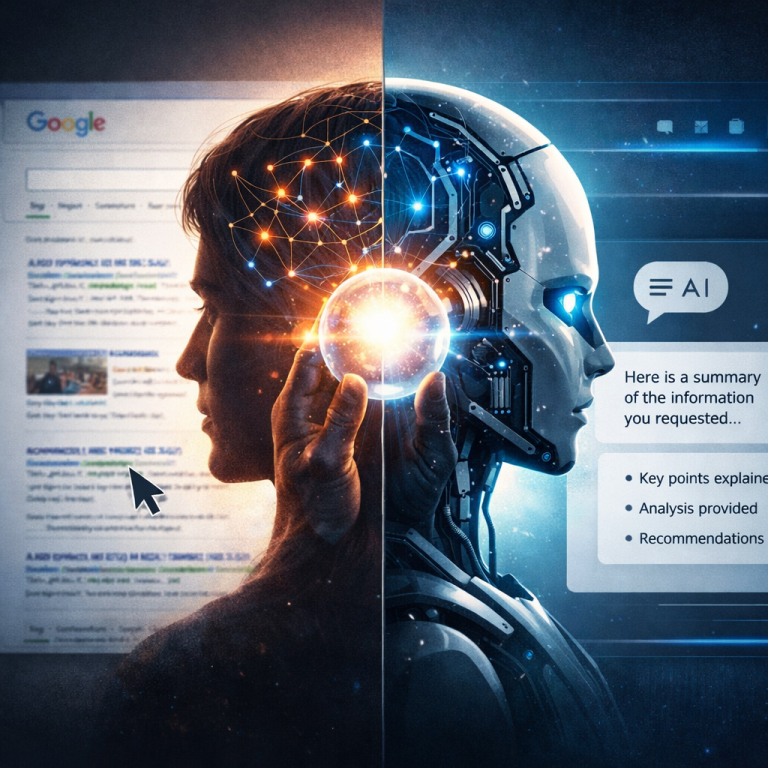
The way people find information online is not changing quietly, but structurally. What long felt self-evident - typing terms into search engines, comparing results, forming one’s own opinion - is increasingly being replaced by something else: a conversation with artificial intelligence. Not because classical search has suddenly become inferior, but because our expectations of knowledge have shifted. It is no longer primarily about finding information, but about interpreting it, condensing it, and assigning meaning.
For simple, clearly defined questions, Google remains the fastest path to an answer. Opening hours, definitions, facts, locations - all of these can be resolved efficiently, reliably, and often without a single click. Classical search is perfectly optimized for this purpose, deeply embedded in browsers, operating systems, and everyday routines. But as soon as a question demands more than a single unambiguous fact - as soon as context, trade-offs, or judgment come into play - behavior shifts. People stop searching and start asking. And increasingly, they ask an AI.
Fragments Versus Narrative
The reason for this shift is less technological than cognitive. Classical search delivers fragments: many perspectives, many sources, many contradictions. That is its strength - and at the same time its greatest weakness. AI, by contrast, delivers a narrative. It synthesizes, organizes, prioritizes, and presents a seemingly coherent answer. It takes over thinking and decision-making effort. That is precisely what makes it so attractive in a world where time is scarcer than information.
Most users are well aware that AI can make mistakes. But the productivity gain outweighs the risk. Ten open tabs, an afternoon of research, and still uncertainty - compared to that, a structured AI response feels like relief. Not because it is always correct, but because it offers orientation. And orientation has become more valuable than completeness.
Why AI Also Wants the Simple Questions
This division of labor - Google for the simple, AI for the complex - is not a stable end state. From a platform perspective, simple search queries are anything but trivial. They are habit anchors, entry points into decision journeys, and economically highly relevant. Whoever controls these touchpoints controls attention, behavior, and ultimately markets. It is therefore naïve to assume that AI will permanently restrict itself to complex research. It wants the simple questions as well.
Paradoxically, these simple questions are the hardest ones to answer reliably. They require absolute accuracy, up-to-date information, and transparent sourcing. One wrong date, one outdated detail, one unclear origin - and trust collapses. Classical search engines were built for this. AI still has to prove this level of reliability, both technically and legally. The bar is high, and the consequences of failure are significant.
Google Is Not Changing the Answer - but the Role of Search
Google’s response is not to “catch up,” but to redefine the playing field. With AI Overviews and generative search modes, Google is transforming the role of search itself. The search engine becomes an interpretation layer. You are not meant to leave Google in order to understand. Answers appear directly on the interface - condensed, pre-structured, seemingly neutral. It is convenient. And that is precisely where the risk lies.
The more answers are served, the less space remains for independent exploration. Zero-click searches increase, organic clicks decline. Knowledge is no longer discovered - it is consumed. The shift is subtle, but profound. It affects not only technology, but our relationship to knowledge itself.
A New Logic of Understanding
This is not about new tools, but about a new logic of understanding. Responsibility is being shifted. Where research once meant working through uncertainty, comparing sources, and tolerating contradictions, it now increasingly means accepting an answer because it sounds plausible and works efficiently. The key question shifts from “Is this information correct?” to “Do I trust the system providing it?”
Why This Comfort Is Dangerous
This is where it becomes critical. Conviction is not the same as truth. Summaries are not the same as insight. And a well-written output does not replace judgment. When research is delegated, verification must become more conscious, not less. Otherwise, a new form of dependency emerges: not on information, but on interpretation.
Search is not disappearing. It is becoming invisible. It retreats behind overviews, assistants, and default interfaces. Simple facts remain search-based for now, complex questions become conversational, and between them emerges a grey zone where answers are convenient, plausible - and dangerously unchecked. The key competence of the future is therefore not prompting, but judgment. Not the ability to ask quickly, but the ability to recognize when an answer must be questioned. And when it does not.