
Blog - AI in Education
Why Our Kids Are Turning into Copy Machines...
... and How to Bring Them Back
By amedios editorial team in collaboration with our AI Partner
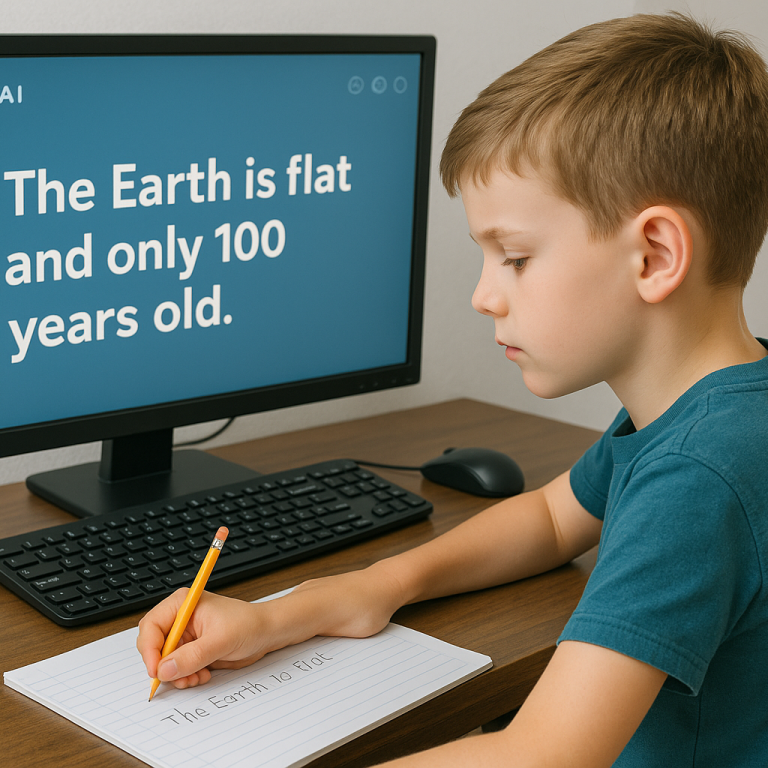
Imagine a child sitting at a computer, typing a question into ChatGPT – "Explain World War II to me" – and printing out a perfect, polished summary. No follow-up questions, no doubts, no personal organization of the facts. Instead: copy, paste, done. This scene has become routine in the era of AI-assisted laziness, where children no longer think but merely consume. And adults? They celebrate it as "progress." This is not progress – it's intellectual self-destruction!
Amedios.org will soon place great emphasis on education and children in dealing with AI. And yes, that is absolutely sensible. AI is here, shaping the world. But before turning young minds into prompt engineers, honesty is required: Where does education with AI for children truly begin? Not with cool coding or ethical dilemmas about robot rights. It starts at the foundation: Thinking. Children are currently learning how to feed a machine rather than training their own brains. The result? A generation growing dumber – not because they are inherently dim, but because it is being allowed. Provocative? Absolutely. But necessary. This will be unpacked with hard facts and radical proposals. Because if the course is not corrected now, the harvest will be adults who can do no more than "Hey Siri, save me."
The Great Copy-Paste: How AI Hijacks Our Learning
It started innocently. In 2022, ChatGPT exploded, and suddenly homework became a joke. "Write me an essay on climate change," the kids type, and boom – a Nobel Prize-worthy treatise is ready. But what do they learn in the process? Nothing. Zero. The learning content? It vanishes into the digital ether. Instead, a fatal dependency emerges: Why think when AI does it better? Why research when Google and company serve up the answer?
The problem is not AI itself – it is neutral, like a hammer. The problem is the approach. Schools celebrate technology without examining whether it erodes the core of learning. Children no longer ask "Why?" or "How does this fit together?" They demand: "Give me the answer." And the system nods approvingly. The outcome: A loss of critical thinking ability that spreads like a virus. Many rely solely on machine input, blindly copying and internalizing nothing. It is as if they are being taught to walk with crutches – and then wondering why their legs atrophy.
The Hard Numbers: Children Are Getting Dumber – it's proved
"Our children are getting dumber" – sounds like panic-mongering? Wrong. Studies lay it out mercilessly. Consider the OECD's PISA results: In the 2022 tests, scores in reading, mathematics, and science declined worldwide. In Germany? A plunge of 25 points in math alone. And why? The OECD itself cites excessive screen time and deficient critical thinking. Children can regurgitate facts but can no longer analyze or argue. A 2023 Stanford University study ("The Impact of Generative AI on Student Learning") goes further: Of 500 tested students, 68% used AI tools for homework, but only 12% could reproduce the content without AI. The rest? Empty shells.
Or look at the American Psychological Association's 2024 work: "Cognitive Offloading in the AI Era." It proves that constant AI use shrinks working memory. Children outsource thinking – like muscles left untrained. Consequence: Less creativity, weaker problem-solving skills. In the UK, the Education Endowment Foundation warned in 2024 of an "AI learning loss": Students misusing AI perform 15–20% worse in unassisted tests. And a 2025 meta-analysis from the University of Toronto states bluntly: "Generative AI correlates with a 10–15% decline in independent thinking skills among adolescents."
These studies are not alarmism. They are warning shots. Children are not growing dumber due to laziness – they are, because a system is being built that rewards laziness. And in countries like the US or Germany, where smartphones are standard from elementary school, it escalates. Imagine: In 10 years, a workforce that collapses without AI. Sounds like sci-fi? It's reality in the making.
Where to Start? Not with AI – with Rebellion Against It
So, where to begin in the education sector for children with AI? Not with "Learn to write prompts." That is like teaching a smoker how to roll better cigarettes. Start with the cornerstone: Learning to think. Yes, it is more important that children learn to think independently again than using AI as a crutch. The entry point? Elementary school. There, where curiosity still thrives before it is suffocated.
- Thinking Before Technology. Schools must introduce "No-AI Zones" – not as bans, but as training camps. Picture an hour of math without calculators or AI. Children calculate with pen and paper, build models, debate without Google. Provocative? Of course. But studies from Finnish education researchers (2023) show: Such analog phases boost problem-solving ability by 25%. It is about enduring frustration – the moment of failure and re-thinking. That is the muscle AI atrophies.
- Questions Over Answers. Teach children to see AI not as an oracle, but as a sparring partner. Rules: Every AI response must be interrogated. "Why do you say that? What sources? What if you're wrong?" A 2024 pilot study from Sweden's Uppsala University tested this: Children who had to "grill" AI retained 40% more content and developed better critical thinking. Turn it into a game: "Find three errors in the AI response." Suddenly, copying becomes uncool – thinking becomes the adventure.
Radical Measures for Parents, Teachers, and Policy
Halting this spiral? It requires a declaration of war on convenience. Here is a provocative action plan – no cuddly advice, but a blueprint for revolution:
Parents as Gatekeepers: As little smartphone use under 14 as possible, no unsupervised AI access. Instead: Family evenings without screens, solving puzzles or inventing stories together. Sounds old-fashioned? Good. A 2024 Harvard Graduate School of Education study confirms: Children with tech-minimalist parents perform better in cognition tests. And yes, it hurts – the kids will complain. But better complaints than discomfort when they fail later without AI.
Teachers, Flip the Classroom: Away with frontal lectures, toward project-based learning. Let children solve problems offline first – then use AI as a supplement. The EU Commission recommends this in its 2025 report "AI in Education": "Technology as a tool, not a teacher." And for provocation: Punish copying harshly. No "fostering understanding" – fail them outright until they get it. Harsh? Necessary. Otherwise, cheaters are bred instead of thinkers.
Policy, Wake Up: Demand laws! France already has AI-free literature tests. Germany? Nothing. Invest in teacher training for "Thinking 2.0" – not coding, but philosophy and logic from grade 1. And yes, subsidize analog playgrounds where kids build instead of browse. UNESCO has warned since 2023: Without countermeasures, a "global intelligence loss" looms. Time to pump billions into schools, not tech hype.
Societally: Make Thinking Sexy. Boycott influencers pushing AI hacks. Celebrate educators who spark kids' reflection instead. And Amedios.org? Launch campaigns: "Think for Yourself – or Die Dumb." Provocative enough? It has to be to break through.
The Wake-Up Call: Before AI Devours Us All
In summary: Yes, education with AI is forward-looking. But only if thinking is rescued first. Children are not growing dumber through genes – but through negligence. Studies scream it out, reality confirms it. If rebellion does not start now – against the easy answer, against quick copying – the world will be one where machines think and humans applaud.