
Blog - AI in Business
The Jevons Paradox Returns: Will We Use AI to Create Less Work - or More?
We were told AI would make life easier — but what if it ends up giving us more work instead of less? The Jevons paradox shows that when something becomes cheaper and faster, we usually do more of it, not less.
Here’s how that dynamic is already shaping business, and why the real challenge isn’t speed — it’s deciding what’s truly worth doing.
In 1865, the British economist William Stanley Jevons observed a phenomenon that would forever change how economists understand progress. During the Industrial Revolution, engineers developed steam engines that were dramatically more efficient than their predecessors. They required less coal to produce the same amount of power — a breakthrough that many believed would reduce Britain’s appetite for coal and ease the strain on its natural resources.
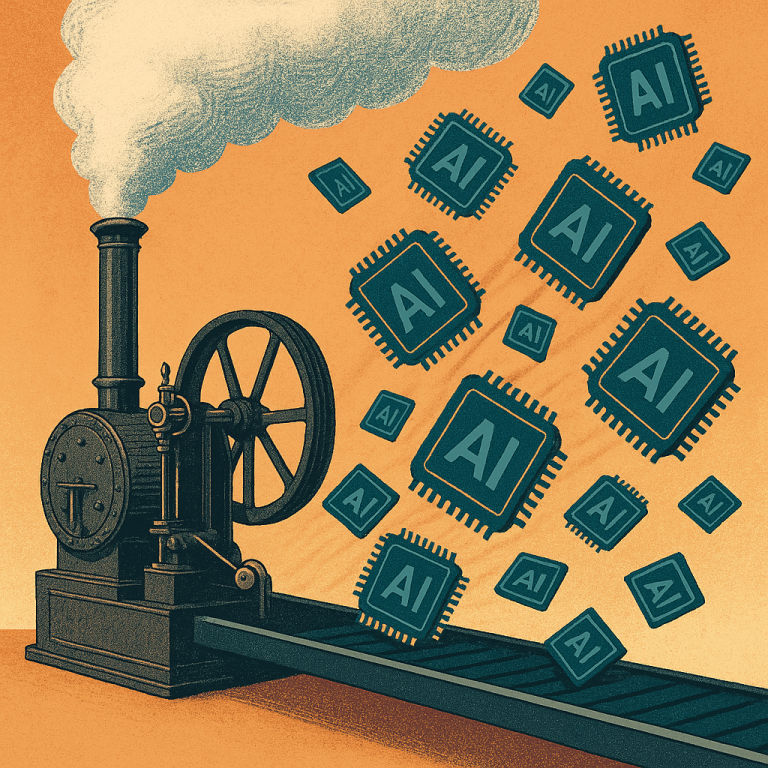
But the opposite happened. As steam power became cheaper and more accessible, industry expanded. New factories opened, new applications emerged, and coal consumption didn’t fall — it exploded. Jevons concluded that efficiency improvements often increase total resource use instead of decreasing it. His insight became known as the Jevons paradox: when the cost of a resource drops, we don’t save it — we use more of it.
More than 150 years later, this paradox is returning in a new form — this time, not in the age of steam, but in the age of algorithms.
From Coal to Compute: The Modern Paradox of Artificial Intelligence
Today, artificial intelligence is doing to cognitive work what the steam engine did to mechanical work. It makes tasks that once required days achievable in minutes. It drafts legal documents, designs marketing campaigns, writes code, analyses data, and generates complex insights with astonishing speed and minimal cost.
At first glance, this seems to promise the same kind of liberation industrialists once hoped for: less human effort, fewer routine tasks, more time for creativity and strategy. Yet if history is any guide, the outcome may be very different. As the cost of knowledge work falls, we may simply do more of it.
This is the essence of the Jevons paradox in the context of AI: when the “price” of producing information, content, or analysis collapses, demand for those outputs expands — often beyond our initial imagination. And instead of freeing us from work, we end up generating more of it.
The Dynamics Behind the Paradox
To understand why, we must look beyond technology and examine human behaviour. Efficiency gains tempt us to expand our ambitions. When a task that used to require significant time and money becomes almost free, we rarely stop at doing the same amount of work faster. We raise our targets.
In business, this dynamic is already visible. A marketing team that once launched five campaigns a quarter now launches twenty. A sales team that once produced two proposal variants now produces ten. A data team that retrained a model once a month now does so daily.
In each case, the unit cost of work falls — but total workload increases.
The same pattern is unfolding in our personal lives. We use AI assistants to draft emails, summarise meetings, and manage calendars — and then accept even more commitments, meetings, and messages because “it only takes a minute.” The time saved does not become free time. It becomes new work.
Where We Are Now: Paradox or Premonition?
Are we already experiencing the Jevons paradox with AI, or are we merely anticipating it?
The answer is: both.
The signs are already visible. Organisations are producing more content than ever before, yet competing for attention has become harder, not easier. The volume of emails, meetings, and documents has increased, not decreased. Product teams run hundreds of experiments, but decision-making often slows down under the weight of data. Even individuals who adopt AI tools often report being busier — not because the tools fail, but because they enable them to take on more.
At the same time, the full extent of the paradox may still be ahead of us. As AI systems become more powerful and more deeply embedded into workflows, the pressure to expand output will grow. Entire categories of work that once seemed too expensive or time-consuming will become routine — and once routine, they will multiply.
Early Indicators: Signs That the Paradox Is Already Here
Several indicators suggest that Jevons’ logic is not just theoretical but actively shaping the AI era.
First, content saturation. Generative tools have lowered the cost of creating articles, videos, and ads to almost zero. The result is an avalanche of digital noise — and companies respond by producing even more to be noticed. Visibility becomes harder, not easier.
Second, decision overload. As AI makes analysis cheaper, organisations produce more reports, dashboards, and models. Yet decisions are often delayed as leaders struggle to synthesise the abundance of information. Instead of clarity, abundance breeds complexity.
Third, compute demand. Each model is more efficient than the last, but total energy consumption for AI is climbing sharply as adoption spreads. Just as cheaper steam engines led to more coal use, cheaper inference leads to more compute consumption.
Fourth, time compression. Individuals use AI to save minutes on tasks, but those minutes are quickly reinvested in more tasks. The workday does not shrink; it simply fills with more activity.
Looking Ahead: Where the Paradox Might Lead
If these trends continue, we may find ourselves in a future where AI has made each unit of work astonishingly efficient — yet the total volume of work far exceeds what we do today. Workflows will be faster but more fragmented. Teams will produce more outputs but struggle to identify what truly matters. The attention of both workers and customers will become the scarcest resource of all.
This future is not inevitable, but it is plausible. Whether the Jevons paradox defines the age of AI depends on how leaders and societies respond. If we use efficiency purely to accelerate existing workflows, we will simply scale the old problems. If we use it as an opportunity to rethink which workflows deserve to exist, we can turn efficiency into real progress.
The Real Question Is Not “How Much” — But “Why”
So will AI give us more work instead of less? If history is any guide, the answer is probably yes — at least unless we actively design against it. Jevons taught us that efficiency alone does not guarantee less consumption; it often guarantees more. The same principle will likely hold true for cognitive work.
The challenge for the AI era is therefore not to make tasks faster, but to ask harder questions about which tasks matter. It is to measure success not by the quantity of output but by the quality of outcomes. And it is to resist the seductive logic of “more” and replace it with the discipline of “enough.”
If we can do that, AI will not just accelerate what we already do — it will transform what we choose to do at all.
Closing Thought: The Paradox Is a Choice
The Jevons paradox is not destiny. It is a mirror. It shows us how we behave when technology removes constraints. If we let AI accelerate everything without asking why, we’ll end up with more of the same — just faster.
But if we use efficiency as a tool to rethink priorities, to focus on what truly matters, and to eliminate what doesn’t, AI won’t make us busier. It will make us better.