
Blog - AI in Business
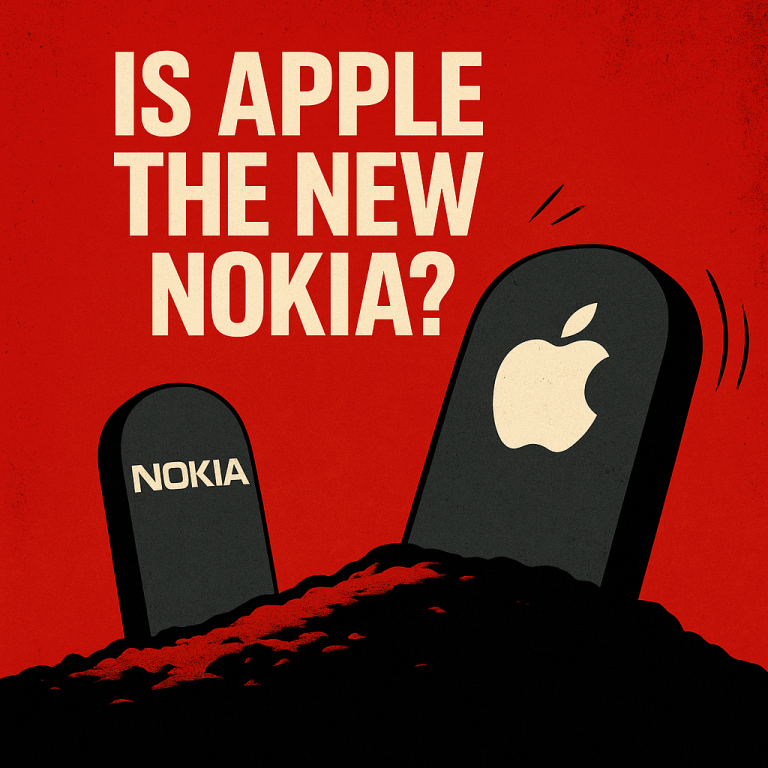
Is Apple the New Nokia? Why the Smartphone Age Seems to Be Already Over
Discover how Apple and its business model might get overrun by new AI-based propositions. So, what comes next - for businesses and all consumers out there?
For nearly two decades, the smartphone has been the most profitable consumer product in human history. It was a once-in-a-century fusion of hardware, software, and connectivity that reshaped entire industries and global value chains. It has been the epicenter of commerce, communication, entertainment, and identity. And at the heart of this era, Apple has been the undisputed hegemon. The company did not only capture the lion’s share of profits but also defined the cultural logic of the mobile age.
But the very forces that once propelled Apple to unprecedented dominance are now signaling the beginning of the end. The smartphone paradigm is entering its late maturity phase. The market is economically saturated, strategically exhausted, and technologically commoditized.
And just as Nokia, once the titan of mobile phones, was blindsided by a platform shift it failed to anticipate, Apple now risks being overtaken by a deeper transformation: the decoupling of digital intelligence from physical devices.
1. Peak Smartphone: Innovation Without Growth
Each September, Apple unveils a “new” iPhone. And each year, the incremental gains like a slightly faster processor, a brighter display, a marginally improved camera are hailed as innovation. But in economic terms, these are not innovations. They are refinements in a mature market, where additional features no longer translate into new value creation.
The evidence is unambiguous: global smartphone shipments peaked in 2017 and have since plateaued, even declined, in most developed markets. Penetration is above 90% in OECD countries. Replacement cycles are lengthening. Margins are compressing. This is precisely how industries behave when they reach the top of their S-curve - and history shows that, at this point, disruption is no longer a risk but an inevitability.
But research shows, that a major shift in technology and customer behavior will revolutionize the smartphone and tablet business. By 2030, more than 70% of digital interactions are expected to occur without a screen - through voice, ambient interfaces, embedded systems, and distributed intelligence.
In other words, the smartphone might not dying because it failed. It could be fading because its economic and functional centrality will be surpassed.
2. The False Salvation: Glasses, Watches, and the Illusion of Innovation
The incumbents know this, even if they do not admit it. The flurry of “new” form factors like AR glasses, VR headsets, smartwatches, and wristband controllers are not breakthroughs. They are hedges. Strategic attempts to prolong the current business model without challenging its underlying logic.
Meta’s smart glasses or Apple’s Vision Pro are emblematic of this reactive mindset. They are still devices. They are still discrete hardware units that must be bought, upgraded, and replaced. They extend the smartphone paradigm; they do not transcend it. And because they are still conceived as products rather than platforms, they inherit the same structural limitations: hardware supply chains, inventory risks, consumer fatigue.
It is a classic case of what Clayton Christensen called the innovator’s dilemma: optimizing the existing revenue engine while failing to build for the next one.
3. The Real Shift: From Devices to Intelligence
The next technological epoch will not be defined by what we hold in our hands but by what surrounds, understands, and augments us. The center of gravity is shifting from devices to intelligence — persistent, personalized, context-aware systems that act less like tools and more like partners.
This transition mirrors broader macroeconomic trends: value creation is moving away from hardware margins and toward recurring, data-driven services. Companies that once competed on industrial design and silicon efficiency will compete instead on the richness of their user models, the depth of their context awareness, and the sophistication of their cognitive architectures.
By 2035, over 80% of consumer-facing software will be built around adaptive, agentic AI rather than static user interfaces. In such a landscape, it will matter less where the intelligence resides — in a phone, a car, a home device, or the cloud — and more how seamlessly it integrates across all of them.
4. The App Collapse: Static Software in a Dynamic World
The signs of this shift are already visible. Entire app categories — once heralded as revolutionary — are stagnating. Dating platforms that once promised human connection now feel transactional. Fitness and nutrition apps have plateaued in engagement. Even productivity tools face declining differentiation.
The reason is structural: static software cannot compete with adaptive intelligence. Why would users manually enter data into siloed apps when a single AI can synthesize their routines, preferences, and goals — and act across multiple domains proactively?
This erosion of engagement is not just a UX problem; it’s a revenue problem. Advertising models dependent on screen time, subscription models reliant on app stickiness — all face structural headwinds as usage migrates away from discrete interfaces toward continuous, AI-mediated experiences.
5. The Post-Device Society: Communication Becomes Context
The economic implications extend beyond software. The very nature of communication — and with it, the foundational business models of entire industries — is about to change.
For over a century, communication technologies have been containerized: the telephone, the television, the smartphone. Each defined by its device, its medium, its ecosystem. But in the next decade, communication will become contextual. It will no longer happen inside platforms like WhatsApp or Zoom. It will be orchestrated — initiated, mediated, and often executed — by intelligent systems that understand intent, timing, and relevance.
By 2032, more than 50% of workplace communication is expected to be agent-initiated — from scheduling to negotiation — reshaping organizational workflows and productivity economics. In consumer markets, conversational commerce will likely follow the same trajectory, transforming how brands engage with users and how users make decisions.
6. The Apple Paradox: Innovating in the Wrong Century
Apple remains one of the most profitable companies in history — but profitability is not the same as inevitability. Its core business model remains structurally dependent on a 20th-century economic logic: high-margin hardware sales, proprietary ecosystems, and incremental service monetization. That logic has built a $3 trillion company. But it also anchors Apple firmly to the very paradigm that is about to be eclipsed.
This is the paradox of incumbency: the stronger the existing model, the harder it is to abandon. But strategic optionality — the capacity to pivot — diminishes with scale. And without a radical redefinition of its role in a post-device world, Apple risks following the same trajectory as Nokia: from dominance to irrelevance, not because it failed to innovate, but because it innovated along the wrong dimension.
7. The World Beyond the iPhone
The smartphone will not disappear overnight. Legacy technologies rarely do. But their economic and cultural centrality fades long before their physical presence does. And that shift is already underway.
The next era of digital life will not revolve around devices, platforms, or even apps. It will revolve around identity, context, and intelligence — the invisible substrate that shapes how we live, work, and connect. Companies that understand this will not ask, “How do we make a better phone?” They will ask, “How do we build a digital intelligence so deeply integrated into people’s lives that the device becomes irrelevant?”
And when that question is answered — likely sooner than Apple imagines — the iPhone will be remembered the way we now remember the Nokia 3310: not as a failure, but as a monument to a world that has already passed.