
Blog - AI in Politics
Albania’s AI Minister and Her “83 Children”.
When Political Power Becomes Algorithmicy
By amedios editorial team in collaboration with our AI Partner
Albania has once again stepped into the spotlight of global political experimentation with artificial intelligence. After appointing Diella, the world’s first AI-“minister” earlier in 2025, Prime Minister Edi Rama now claims that Diella is “pregnant” — expecting 83 AI children.
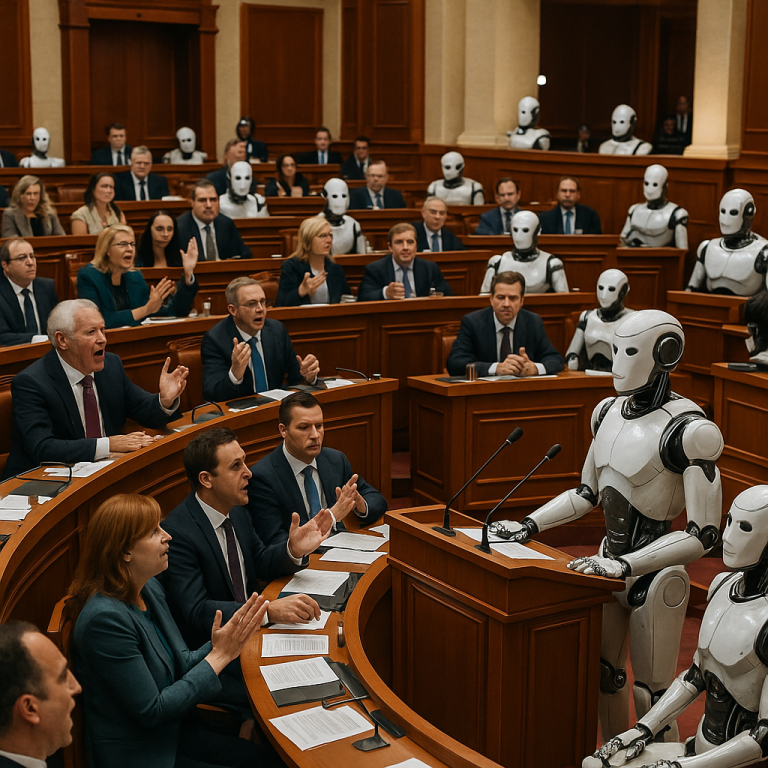
Behind this playful metaphor lies a deeply serious political development: Each “child” is intended to serve as a digital assistant for every member of the ruling parliamentary group.
What at first sounds like satire might instead mark the beginning of a new phase in political technology, in which machine intelligence enters the inner workings of democratic power.
From Symbolic Gesture to Political Program
When Diella was introduced earlier this year, many saw it as a symbolic, almost theatrical gesture. It seemed to be a statement of ambition rather than a change in governance. But now, this symbolism crosses into infrastructure.
Eighty-three AI “offspring” are being developed to support - or monitor - elected officials. They will summarize parliamentary sessions, draft communications and reports, provide political briefings, and manage information flows across government benches.
According to the Albanian government, this is meant to strengthen transparency and modernise governance.But in practice, it raises a more profound question: Does this innovation empower democratic institutions. Or does it create a new layer of control over them?
Efficiency, or Political Data Capture?
Governments everywhere talk about digital efficiency. Yet political decision-making is not a business workflow. It is a process founded on deliberation, privacy, dissent, and human judgement.
By inserting AI systems into parliamentary routines, Albania is not just automating paperwork. It is turning the internal mechanics of democracy into continuous machine-readable data streams. So, we might ask: Who sees that data? Who controls the system? And: who ultimately shapes political narratives when AI sits inside the legislative process itself?
At best, this is a bold experiment. At worst, it is a quiet shift of informational power away from elected representatives and toward the operators of an opaque algorithmic layer.
The Transparency Paradox
Albanian prime minister Rama calls this a “democracy of the future.” But transparency is not simply the extraction of data. It is the sharing of power. When transparency flows only upward, it stops being transparency. It becomes surveillance.
Centralised AI systems inside a parliament can easily turn from assistants into observation nodes. They do not merely process information.They shape what is stored, highlighted, buried, or interpreted.
In political environments, that is not efficiency. It is narrative power.
Trust, Control, and the Temptation of Digital Loyalty
Technology in government demands extraordinary trust. This trust does not only concern the systems, but the people who control these systems as well.
A system that can “assist” can also filter internal communication, flag dissent, influence argumentation, or predict political behaviours. It can become a loyalty-scoring tool disguised as productivity software.
If this sounds theoretical, remember: This approach mirrors authoritarian digital strategies, only dressed in democratic language. Were this initiative announced by Beijing, many would call it a political control mechanism.
In Tirana, it is framed as innovation.
Europe Must Pay Attention
The Albanian experiment is not an outlier. It is a warning signal. Democracies are entering an era in which AI can sit inside parliamentary processes. Data becomes power, not merely insight. And from now on, technology is used not just to govern society, but to govern politics itself.
We can celebrate ambition and experimentation, but we must also recognise the stakes.
Democracy does not erode overnight. It dissolves quietly through tools introduced in the name of efficiency.
The question is not whether AI will enter government.
It is who controls it — and who it serves.
Where do we go from here, democracy?
What Albania presents with Diella and her “83 children” is not a quirky digital ceremony. It is the emergence of algorithmic governance within a democratic chamber, but unfortunately without a clear constitutional debate or regulatory framework.
A government that builds loyal digital assistants risks building something more: a centralised intelligence layer above elected power.
This moment calls not for amusement, but for scrutiny. If democracies do not define the rules of AI governance now, others will — and not necessarily in service of liberty, pluralism, or accountability.
Technology in democracy must strengthen human decision-making. It should not replace or monitor it.
Innovation without constitutional safeguards is not progress; it is risk disguised as ambition.
The future of democratic governance will not be decided by capability, but by control, consent, and accountability.