
Blog - AI in Society
AI - The New Strategic Battleground.
How Artificial Intelligence Is Redrawing the Global Map of Power
By amedios editorial team in collaboration with our AI Partner
1. AI - The New Strategic Technology
Every era of technological progress has produced a new center of global power. In the 19th century, it was industrial capacity that determined which nations ruled the world. In the 20th century, it was nuclear capability and space technology that shaped military dominance and geopolitical influence. In the 21st century, the decisive factor is no longer steel, oil, or even weapons. It is artificial intelligence.
AI is not just another tool of economic growth or industrial efficiency. It is the strategic technology of the century. It determines who controls the global flow of information, who wins wars, who leads the digital economy, and ultimately, who sets the rules of the international order. The ability to build, train, deploy, and govern advanced AI systems is quickly becoming the single most important determinant of national power.
This is not hyperbole. Policymakers in Washington, Beijing, Brussels, and beyond increasingly speak of AI in the same breath as nuclear weapons, financial systems, or energy security. The nations that dominate AI will not only reap enormous economic benefits. They will wield disproportionate influence over the future of humanity itself.
The implications are profound. In this new era, geopolitical competition is no longer fought solely with armies, trade agreements, or alliances. It is fought with data, compute power, algorithms, and model architectures. And just as the nuclear arms race defined much of the 20th century, the AI race is poised to define the 21st.
2. From Innovation to Power: The AI Arms Race
The global competition over AI is not theoretical. It is happening right now. And unlike past technological races, this one is being waged simultaneously on multiple fronts: economic, technological, military, ideological, and regulatory. At its core, it is a struggle over who will write the operating system for the 21st-century world order.
The United States: Private Innovation, Strategic Dominance
The United States currently leads the global AI landscape, largely because of its unparalleled ecosystem of private-sector innovation. Silicon Valley giants like OpenAI, Google, Anthropic, and Meta are driving foundational model development at a scale no other country can match. U.S.-based cloud providers like Microsoft Azure, AWS, and Google Cloud dominate the compute infrastructure needed to train and deploy advanced systems.
This technological leadership translates directly into geopolitical leverage. American companies control many of the world’s most widely used AI platforms and APIs, shaping how billions of people interact with digital services. U.S. chipmakers like NVIDIA and AMD dominate the GPU market, giving Washington a powerful chokepoint over global AI development.
But the U.S. approach also comes with vulnerabilities. Heavy reliance on private actors means national AI strategy is often fragmented. And while the U.S. leads in innovation, it lags behind in governance. This is a strategic gap that currently international competitors exploit.
China: State-Driven Acceleration
China is the only country capable of challenging U.S. dominance across the full spectrum of AI power. The country is doing so through a highly coordinated, state-led strategy. Beijing views AI not just as a technology, but as a tool of national rejuvenation and global influence.
Through massive state subsidies, industrial policy, and direct integration with military planning, China is rapidly scaling its capabilities. Tech giants like Baidu, Alibaba, Tencent, and Huawei are heavily aligned with state priorities, building everything from large language models to AI-enabled surveillance systems. China’s vast data resources are fueled by its population size and looser privacy constraints. This provides a key strategic advantage.
Yet China faces its own challenges: export restrictions on advanced chips, limited access to cutting-edge semiconductor equipment, and concerns about global trust and adoption of its AI standards. Nevertheless, its long-term ambition is clear: to become the global hub for AI infrastructure, platforms, and governance. This AI juggernaut wants to shape the norms that govern their use.
The European Union: Regulatory Power as Strategy
Europe has neither the scale of American innovation nor the centralized industrial policy of China. But it wields a different kind of power: regulatory influence. The EU’s AI Act is the world’s first comprehensive legal framework for artificial intelligence. This legal framework is designed not just to protect European citizens, but to set global standards.
The “Brussels Effect” has worked before: GDPR reshaped global privacy practices, and environmental standards set in Europe now shape supply chains worldwide. If the AI Act achieves similar global reach, the EU could emerge as a powerful “norm entrepreneur”. This would shape the rules of the AI age even without dominating its technology stack.
However, this strategy is not without risks. If regulation becomes too restrictive, Europe could find itself technologically dependent on foreign models and platforms. The challenge is to strike a balance between governance leadership and innovation capacity.
The Rest of the World: Strategic Alignment and Dependency
Beyond the “AI Big Three,” most countries are unlikely to develop fully sovereign AI ecosystems. Instead, they will align with one of the major blocs or become dependent on external platforms and standards. Japan and South Korea are partnering with the U.S. on advanced chip and model development. Gulf states like the UAE and Saudi Arabia are investing heavily in compute infrastructure to position themselves as regional AI hubs. Meanwhile, nations in Africa, Latin America, and Southeast Asia face the risk of becoming “digital colonies,” consuming AI built elsewhere without influencing how it works.
The geopolitical map of the AI era is thus being redrawn - not around borders or military bases, but around data flows, compute networks, and model ecosystems. Power will increasingly accrue to those who control the underlying infrastructure and to those who can make others depend on it.
3. Infrastructure as Influence: The New Strategic Battleground
If data is the new oil, then compute is the new steel. In the age of AI, control over both is becoming a defining source of geopolitical power. The nations, companies, and alliances that dominate the global infrastructure of artificial intelligence will not just run the most advanced models. They will set the standards, shape the dependencies, and determine who gets to participate in the digital economy of the future.
This isn’t an abstract idea. It’s already happening and the new power map is forming not around borders or armies, but around semiconductors, cloud platforms, data pipelines, and model ecosystems. The tools that train and deploy AI are no longer merely technological resources. They are strategic assets and increasingly, geopolitical weapons.
The Silicon Chokepoints: Chips as Power
At the heart of every AI system lies one indispensable component: semiconductors. Advanced GPUs and AI accelerators are the engines that train massive models and run their inferencing workloads. Without them, AI development slows to a crawl or stops altogether. That’s why control over semiconductor supply chains has become one of the most consequential levers of power in the 21st century.
Today, the United States and its allies hold a near-monopoly on the most advanced chips and the tools to manufacture them. Companies like NVIDIA and AMD dominate the global GPU market. The Netherlands’ ASML produces the world’s only extreme ultraviolet (EUV) lithography machines - critical to making chips below 7 nanometers. And Taiwan’s TSMC remains the undisputed leader in cutting-edge fabrication.
This concentration gives Washington and its partners enormous strategic leverage. Export controls on advanced chips to China, for example, have significantly slowed Beijing’s progress in building frontier AI models. Similarly, the U.S. has persuaded key allies like Japan and the Netherlands to restrict the sale of advanced chipmaking tools and thereby effectively building a “silicon wall” around the most powerful technologies.
But chokepoints cut both ways. The U.S. depends on Taiwan for more than 90% of the world’s most advanced chips. This creates a vulnerability with profound security implications, especially given rising tensions across the Taiwan Strait. As a result, the global race for semiconductor self-sufficiency is accelerating, with the U.S., China, the EU, and others pouring billions into domestic chip production.
Data: The Strategic Resource of the AI Century
If compute is the engine, data is the fuel. Data's strategic value is hard to overstate. AI models are only as good as the information they’re trained on. Nations with access to large, high-quality, and diverse datasets gain a significant advantage in building more capable, context-aware systems.
Here, the balance of power looks very different. China’s vast population, ubiquitous surveillance infrastructure, and comparatively lax data protection laws give it access to enormous volumes of behavioral and biometric data. This turns out to be a key advantage in training AI for real-world applications. The United States, by contrast, leads in the availability of open web data and corporate datasets, while Europe’s strict privacy regulations (like GDPR) often limit access, potentially slowing innovation.
The result is an emerging data geopolitics: countries are competing not just for raw information, but for the legal, technical, and diplomatic means to acquire, share, and exploit it. Data localization laws, cross-border transfer restrictions, and state-backed data alliances are all tools in this contest. Whoever controls the flow of data controls the development and direction of AI itself.
Cloud and Compute Networks: The New Digital Infrastructure
Beyond chips and data, the third pillar of AI power is compute infrastructure. It consists of massive global networks of data centers and cloud platforms that host and deliver AI capabilities. These networks are not just technical backbones. They are spheres of influence.
American companies dominate this landscape. Amazon Web Services, Microsoft Azure, and Google Cloud together control more than two-thirds of the global cloud market. Their infrastructure underpins not just corporate AI projects but also government services, healthcare systems, and critical public-sector functions worldwide. This dominance effectively extends U.S. influence deep into the digital operations of other nations.
China is rapidly building its own alternatives with Alibaba Cloud and Huawei Cloud expanding into Belt and Road countries as part of a broader geopolitical strategy. Europe, meanwhile, is trying to build “digital sovereignty” through initiatives like GAIA-X, but struggles to match the scale and speed of American and Chinese platforms.
The result is a fragmented cloud landscape that mirrors and reinforces geopolitical alliances. Nations and companies increasingly face a strategic choice: integrate into the U.S.-led ecosystem, align with China’s digital sphere, or attempt the difficult path of sovereign infrastructure. Each choice comes with its own dependencies, risks, and political implications.
Standards and Platforms: The Hidden Layer of Power
Perhaps the most overlooked and underestimated form of AI infrastructure power lies not in hardware or data, but in standards and platforms. The organizations that define how AI is built, deployed, and governed shape the entire technological and political environment around it.
This is why Washington and Beijing are racing not just to build models but to set the rules through export controls, AI safety frameworks, model evaluation benchmarks, and technical protocols. Whoever’s standards become dominant will effectively control the “operating system” of the global AI economy.
We are already seeing this dynamic play out. The U.S. National Institute of Standards and Technology (NIST) has published influential guidelines on AI risk management. China has proposed international AI governance principles through the United Nations. And private companies - from OpenAI to Anthropic - are shaping norms through APIs, developer ecosystems, and licensing terms.
Standards may sound dull, but they are immensely powerful. They determine who can participate in the AI economy, under what conditions, and on whose terms. In the long run, they may matter as much as chips or data - if not more.
In the AI century, infrastructure is not a neutral technical foundation. It is the terrain of geopolitical competition itself. Control over chips, data, compute, and standards is becoming the modern equivalent of controlling oil, trade routes, or nuclear arsenals. Those who master them will shape the balance of global power for decades to come.
4. AI as a Weapon: From Cyber to Cognitive Warfare
Artificial intelligence is not just a driver of economic growth or a tool of digital transformation. It is fast becoming one of the most powerful weapons in the modern geopolitical arsenal. It's a force capable of destabilizing nations, disrupting economies, and reshaping the nature of war itself.
This isn’t science fiction. Around the world, governments and non-state actors are already experimenting with AI not only to enhance existing military and intelligence capabilities but to create entirely new domains of conflict. What nuclear weapons were to the 20th century, AI-powered cognitive warfare may be to the 21st.
From Kinetic to Algorithmic Power
For centuries, military dominance was measured in tanks, missiles, and aircraft. In the 21st century, it will be measured in algorithms. AI enables precision, speed, and scale that no conventional force can match — and it is transforming every layer of the battlefield.
- Autonomous weapons: AI-powered drones and loitering munitions already operate semi-independently in conflicts from Ukraine to Nagorno-Karabakh, identifying and attacking targets without direct human input.
- Intelligence dominance: AI systems sift through vast quantities of satellite imagery, intercepted communications, and social media data to detect threats and guide strategic decisions faster than any human analyst.
- Logistics and decision support: Predictive models optimize troop movements, supply chains, and maintenance cycles, turning military readiness into a real-time, data-driven science.
The result is a widening gap between AI-enabled militaries and those without such capabilities — a gap that may prove just as decisive as the invention of gunpowder or nuclear weapons.
Cyberwarfare: Faster, Smarter, More Devastating
Cyber operations were already the “fifth domain” of warfare. With AI, they are becoming far more dangerous. Machine learning models can automatically discover vulnerabilities, design sophisticated phishing attacks, or adapt malware in real time to evade detection.
In 2023, NATO analysts warned that AI-driven cyberattacks could penetrate critical infrastructure in minutes instead of days. Automated exploitation tools can now target thousands of systems simultaneously, while generative models can craft social engineering messages tailored to specific individuals with near-perfect psychological precision.
The terrifying reality is that AI doesn’t just make cyberwarfare more efficient. It makes it more democratic. Actors with minimal technical skills can now access powerful, AI-enhanced offensive tools on the dark web, lowering the barrier to entry for state and non-state attackers alike.
Information Warfare and the Cognitive Battlefield
The most profound and perhaps most dangerous application of AI in conflict is not physical or digital, but cognitive. Wars are no longer fought solely over territory or resources; they are fought over perception, belief, and consent.
AI-powered disinformation campaigns can create fake news, synthetic media, and entirely fabricated events at a scale and speed never before possible. Deepfake videos of leaders declaring war, fabricated protest footage, or AI-generated news articles seeded across thousands of bot accounts can destabilize societies from within - often without a single shot being fired.
This “cognitive warfare” is not theoretical. In 2024, researchers documented AI-generated disinformation campaigns targeting elections in over a dozen countries. These campaigns don’t need to persuade everyone - only to confuse enough people to paralyze democratic decision-making and erode trust in institutions.
The battlefield has shifted from the streets to the screens and from soldiers’ bodies to citizens’ minds.
Hybrid Warfare: Blurring the Lines Between War and Peace
The power of AI lies in its ability to merge all domains of conflict - cyber, informational, economic, and kinetic - into seamless hybrid strategies. A modern attack might begin with AI-generated propaganda, followed by a wave of automated cyberattacks, and culminate in drone strikes guided by real-time data analytics.
Such tactics are already being deployed. Russia’s invasion of Ukraine, for example, has combined disinformation campaigns, AI-assisted cyberattacks, and autonomous systems on the battlefield. China’s “Three Warfares” doctrine, which emphasizes psychological, media, and legal warfare, increasingly relies on AI to execute influence operations with surgical precision.
The result is a new kind of war: one that is always on, often invisible, and difficult to attribute. Traditional concepts like “front lines” or “declarations of war” no longer apply. In the age of AI, conflict seeps into every layer of society, from your smartphone feed to your power grid.
Trend: The Rise of AI-Enabled Authoritarianism
The weaponization of AI is not limited to the battlefield. Authoritarian regimes are deploying AI for population control, surveillance, and repression on an unprecedented scale. Facial recognition networks, predictive policing algorithms, and real-time sentiment analysis tools give governments the power to monitor and manipulate populations with near-total precision.
China’s social credit system is is a breathtaking example of how AI can fuse state power with data to enforce political loyalty. Similar tools are being exported to dozens of countries in Africa, the Middle East, and Southeast Asia, creating a new “authoritarian tech stack” that could entrench digital dictatorships for decades.
In this context, AI is not just a tool of statecraft. It is a pillar of regime survival and a potent export in the global competition between democratic and authoritarian governance models.
The weaponization of AI marks a turning point in the history of conflict. Wars will no longer be fought solely with armies or missiles. They will be fought with algorithms, influence operations, and synthetic realities. The greatest threat may not be a drone in the sky or a virus in the grid, but a lie on your screen that you cannot recognize as false.
5. Autonomous Warfare: The Rise of Machine Armies
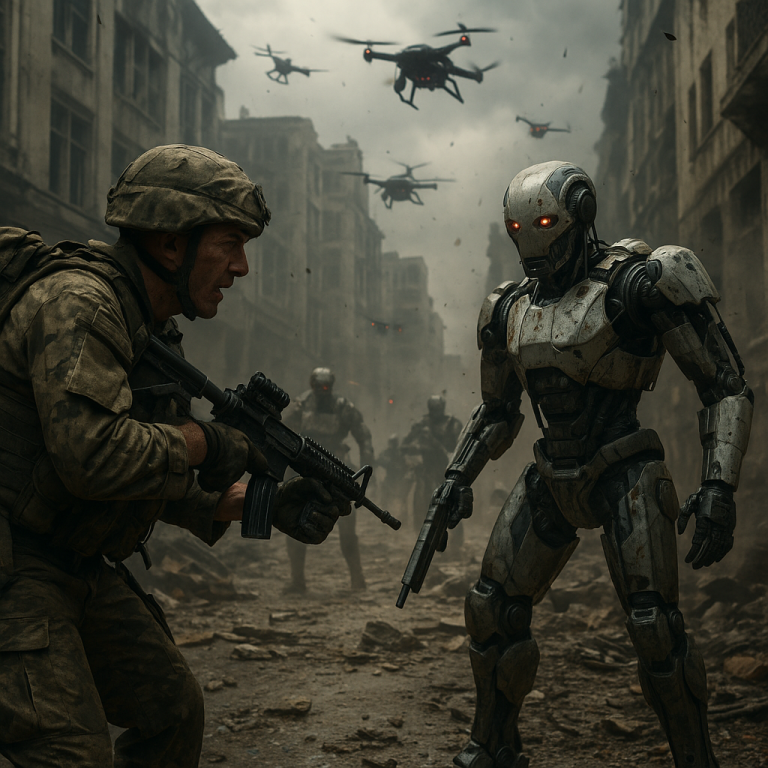
The age of human-centric warfare is ending. Across the world’s most advanced militaries, artificial intelligence is no longer confined to the realms of data analysis, intelligence, or logistics. It is moving into the very heart of the battlefield. Here it is transforming weapons, tactics, and the very nature of combat itself. The result is nothing less than a historic shift: wars fought increasingly by machines, not men.
From Steel to Silicon: A Paradigm Shift in Warfare
For over a century, military power was measured by how many tanks, ships, aircraft, or troops a nation could deploy. But in the AI era, the decisive factor will be how well those systems think. Once a weapon system is no longer limited by human reaction times, cognitive load, or physical endurance, it enters a new category of capability that is faster, more adaptive, and often deadlier than anything that came before.
AI-enabled weapons don’t just augment existing military tools. They redefine them. Traditional platforms like fighter jets, artillery systems, and armored vehicles are being retrofitted with autonomous decision-making capabilities, while entirely new categories of robotic systems are emerging, designed from the ground up to operate without human oversight.
The Drone Swarm Revolution
No technology captures this shift better than the rapid rise of autonomous drones. What began as simple reconnaissance tools has evolved into fully independent strike platforms capable of identifying, selecting, and engaging targets in real time.
The true power of AI comes into play when these systems operate not individually, but in swarms as coordinated networks of hundreds or even thousands of drones that communicate, maneuver, and attack cooperatively. These swarms can overwhelm traditional air defenses, adapt mid-mission to changing conditions, and execute complex strategies without a single human command.
Military planners increasingly believe that swarm tactics will define the next generation of aerial warfare which will render conventional fighter jets and surface-to-air missile systems obsolete. And because such swarms can be built cheaply and deployed en masse, they dramatically lower the cost and risk of waging war.
Autonomous Land and Air Combat
The AI transformation is not limited to drones. Unmanned ground vehicles are now capable of patrolling borders, clearing mines, and even engaging enemy forces autonomously. AI-piloted aircraft are already being tested as “loyal wingmen” that fly alongside human pilots, making independent tactical decisions and absorbing enemy fire. And next-generation armored vehicles and tanks are being designed to coordinate with other units automatically that share sensor data, select routes, and prioritize targets with no human intervention.
In future conflicts, the most advanced armies may deploy machine-machine battle groups: robotic vehicles, autonomous artillery, and AI-controlled air support working together as a seamless, adaptive force. The human commander’s role will shift from directing each unit to setting strategic objectives and letting algorithms execute the rest.
The End of the Human Soldier?
While soldiers will remain on the battlefield for decades to come, their role is changing fundamentally. Rather than being the main fighting force, they will increasingly become supervisors, coordinators, and decision-makers overseeing fleets of autonomous systems. Some militaries are already experimenting with exoskeletons, cognitive support systems, and real-time battlefield AI assistants. These technologies will augment human capabilities rather than replace them outright.
But the long-term trajectory is clear: as machines outperform humans in speed, precision, and survivability, the logic of military efficiency will steadily push humans out of direct combat roles. Future wars may be fought primarily by robotic forces. This will reduce human casualties drastically, but will have potentially devastating consequences for how easily conflicts can be initiated.
The Strategic Consequences: Cheaper Wars, Lower Thresholds
The automation of warfare is not just a technological revolution. It’s a geopolitical one. Historically, the human and political costs of war acted as natural brakes on escalation. Democracies, in particular, were reluctant to deploy troops if public opinion risked turning against them.
Autonomous systems change that calculus. When wars can be fought with minimal human involvement, the political threshold for conflict drops. States may be more willing to launch limited strikes, conduct covert operations, or escalate small disputes into armed confrontations, because the human cost is no longer a decisive factor.
Moreover, as the cost of autonomous weaponry falls, non-state actors and smaller nations will gain access to capabilities once reserved for superpowers. AI-driven drone swarms, robotic ground forces, and autonomous cyber-physical weapons could become the great military equalizers of the 21st century, but also the catalysts for new instability.
The rise of autonomous warfare marks the dawn of a post-human battlefield where the decisive edge lies not in manpower or firepower, but in machine intelligence. It promises fewer human casualties but also greater unpredictability, lower thresholds for conflict, and unprecedented risks of escalation. As AI takes command of the battlefield, the rules, ethics, and politics of war will need to be rewritten from the ground up.
6. Governance and Resilience: How Democracies Can Fight Back
Artificial intelligence is transforming the nature of power and with it, the nature of threat. The same algorithms that can decode proteins and optimize supply chains can also destabilize democracies, automate warfare, and manipulate human perception at scale. The question is no longer whether AI will reshape global security, but how we will respond to it.
No single government, company, or alliance can solve this alone. The weaponization of AI is too complex, too diffuse, and too global. It demands a whole-of-society response that unites policymakers, technology firms, international institutions, civil society, and private industry in a common cause: to defend the open societies, democratic institutions, and shared truths that define our world.
Rethinking Security in the Age of AI
Traditional security frameworks are built on borders, armies, and treaties. But AI blurs all three. Attacks can originate anywhere, cross national boundaries at the speed of light, and operate below the threshold of conventional conflict. A deepfake video of a world leader can destabilize an election. A rogue algorithm can cripple a power grid. A swarm of autonomous drones can launch a strike before diplomats have time to react.
To respond, democracies must update their strategic thinking. That means expanding the definition of national security beyond tanks and troops in order to include data integrity, information ecosystems, cognitive resilience, and algorithmic accountability. The battle for security in the AI era will be fought not only in the skies or cyberspace, but also in minds, markets, and digital infrastructures.
Building the Global Rulebook: Treaties, Norms, and Governance
The first step is to establish clear international norms and agreements for the use and misuse of AI. Just as nuclear treaties, chemical weapons conventions, and arms control regimes stabilized earlier eras of technological disruption, the AI age needs its own governance architecture:
- Multilateral Treaties on Autonomous Weapons: Democracies should lead negotiations on new conventions limiting or banning fully autonomous lethal systems, establishing accountability for human oversight, and defining red lines for AI use in conflict.
- Global Standards for Synthetic Media: International frameworks should be developed through the UN, OECD, and G7. These programs should mandate transparency in AI-generated content, require labeling and traceability, and set penalties for malicious use.
- AI Safety and Alignment Protocols: Governments and tech companies must collaborate on baseline safety testing, red-teaming standards, and independent audits of frontier models before deployment.
These agreements will not eliminate AI threats, just as nuclear treaties did not eliminate nuclear weapons. But they can raise the cost of misuse, create shared expectations, and provide a legal foundation for accountability.
Regulating the Private Sector: From Voluntary Principles to Enforceable Rules
For now, much of the world’s AI power lies not in governments but in the hands of a handful of private companies. These firms control the largest models, the most powerful infrastructure, and the most influential platforms. They are, in effect, geopolitical actors and they must be treated as such.
Voluntary self-regulation is no longer enough. Democracies must establish binding legal frameworks that govern how AI is trained, deployed, and commercialized. That includes:
- Mandatory transparency reports for high-risk models.
- Liability regimes for damages caused by autonomous systems.
- Licensing requirements for the development and export of frontier AI.
- Strict limits on surveillance and biometric data use.
Regulation should not stifle innovation. But it must ensure that innovation does not undermine democratic institutions or public safety.
Cognitive Defense: Strengthening the Human Firewall
Technology alone cannot solve the problems technology creates. The fight against AI-enabled disinformation, manipulation, and cognitive warfare will ultimately be won or lost in the minds of people. Democracies must invest heavily in societal resilience:
- Education and Media Literacy: Equip citizens to recognize deepfakes, identify misinformation, and verify sources. A digitally literate population is far harder to deceive.
- Authenticity Infrastructure: Embed verification layers (like content passports and authenticity registries) into platforms, browsers, and devices, so that users know what they’re seeing and where it comes from.
- Rapid Response Mechanisms: Create joint public-private “disinformation response units” to detect and neutralize malicious campaigns before they spread.
The goal is not to eliminate manipulation — an impossible task — but to make societies more immune to it.
Resilient Alliances: Democracies Must Act Together
No democracy can fight the weaponization of AI alone. The networks of influence, infrastructure, and disinformation that underpin AI threats are global and the response must be too. That means forging new alliances and coalitions specifically designed for the AI era:
- AI NATO: Expand existing defense alliances to include coordinated cyber defense, shared AI R&D, and collective deterrence against algorithmic attacks.
- Democratic Data Alliances: Pool trusted datasets among like-minded nations to compete with authoritarian data monopolies.
- Global Monitoring Systems: Create shared early-warning networks to track emerging threats, detect deepfakes, and monitor autonomous weapons deployments.
Collective action can amplify resilience. A single nation might struggle to regulate or retaliate against malicious AI use, but an alliance representing half the global economy and most of its data can.
The Role of Civil Society and Industry
Governments cannot build resilience alone. Civil society organizations, universities, and the private sector play a vital role in shaping norms, building tools, and holding both states and companies accountable.
Tech companies, in particular, must embrace their responsibility as custodians of critical infrastructure. That means proactively building safety features, investing in authenticity systems, and refusing to deploy products that they know will cause harm.
Meanwhile, independent watchdogs, researchers, and NGOs must have the resources and legal protection to audit AI systems, expose abuses, and inform the public. A vibrant civil society is one of democracy’s greatest defenses and one of authoritarianism’s greatest vulnerabilities.
Resilience in the AI age is not a single policy, treaty, or technology. It is an ecosystem of governance, regulation, alliances, education, and public engagement. It is the sum of thousands of actions, across hundreds of institutions, working toward one goal: ensuring that the most powerful technology humanity has ever built strengthens democracy, rather than eroding it.
6. The Future of Power: Strategic Scenarios for 2040
Artificial intelligence will not merely influence the 21st century. It will define it. By 2040, the nations, companies, and alliances that master AI will shape the global order, redraw the map of power, and determine the trajectory of human civilization itself.
But the path from today’s chaotic AI race to that future is not predetermined. It will be shaped by political decisions, corporate strategies, technological breakthroughs, social movements, and - above all - the choices democracies make in the next decade.
Below are four plausible strategic scenarios for the AI-driven world order of 2040. Each represents a different equilibrium of power, technology, and governance — and each carries radically different implications for democracy, security, and humanity’s future.
Scenario 1: Democratic AI Order – Trust, Alliances, and Ethical Power
Democracies successfully adapt to the AI age, building strong alliances, establishing global governance standards, and aligning technology with human rights and the rule of law.
A “Digital Atlantic Alliance” emerges, uniting the U.S., EU, Japan, and key democracies in Asia and Africa under a shared framework for AI governance. Global treaties restrict autonomous weapons, mandate transparency for AI-generated content, and establish clear accountability regimes for algorithmic decision-making.
Most major AI platforms are interoperable, auditable, and subject to democratic oversight. Standards like content passports and global authenticity registries become the norm.
Citizens trust information ecosystems again thanks to robust verification infrastructure and media literacy programs. Elections remain competitive and credible.
In this scenario, power is diffuse but stable. Innovation thrives under democratic norms, and authoritarian models struggle to compete with the combined scale of democratic alliances. AI becomes a stabilizing force — one that enhances prosperity and strengthens open societies.
Scenario 2: AI Bipolarity – U.S. and China Divide the World
The world fractures into two competing technological blocs, each led by a superpower with its own infrastructure, standards, and spheres of influence. The United States dominates AI platforms, chips, and cloud services in the Western hemisphere, while China builds a parallel ecosystem across the Global South and Eurasia.
Data flows, model architectures, and supply chains become geopolitically segmented. Nations are forced to choose sides - often aligning with the bloc that controls their digital infrastructure.
Competing standards lead to fragmented regulation, incompatible systems, and “digital borders” that divide the internet into rival spheres.
Proxy conflicts erupt over access to compute resources and key data hubs, while alliances like BRICS+ and the Digital Quad shape a new Cold War.
In this scenario, stability is maintained through deterrence rather than cooperation. Innovation continues, but interoperability suffers, and global governance stagnates. Smaller nations risk becoming digital colonies of one bloc or the other. The world resembles a 21st-century version of the Cold War, but fought with algorithms, not missiles.
Scenario 3: Authoritarian Singularity – AI-Powered Control States
Authoritarian regimes gain a decisive advantage in AI development and deploy it to entrench their power at home and export digital authoritarianism abroad. Massive state-run data regimes and vertically integrated AI-industrial complexes allow authoritarian states to outpace fragmented democracies in frontier model development.
Surveillance systems powered by multimodal AI track populations with near-total precision, enabling predictive policing, real-time censorship, and algorithmic social control. “Digital Belt and Road” initiatives export this technology to dozens of developing nations, creating a global network of AI-enabled autocracies.
Elections in democratic states are repeatedly undermined by disinformation and cognitive warfare, eroding public trust and enabling authoritarian influence even abroad.
In this scenario, liberal democracy enters a period of global retreat. The fusion of AI and state power produces regimes that are more stable and more repressive than any in history. Human rights norms collapse, and dissent becomes algorithmically impossible. The world enters a new era of “AI-backed autocracy.”
Scenario 4: Chaotic Multipolarity – AI Outpaces Governance
No single power dominates, and governance fails to keep up with technological change. The result is a fragmented, unstable world where AI accelerates geopolitical disorder. Rapid innovation by private companies, rogue states, and non-state actors leads to the uncontrolled proliferation of powerful AI systems.
Autonomous weapons, disinformation tools, and deepfake campaigns are widely accessible, enabling terrorist groups, militias, and extremist movements to wield capabilities once reserved for states. Cyberattacks on critical infrastructure become routine.
Elections are constantly manipulated. Conflicts flare unpredictably as AI miscalculations trigger escalation. Economic inequality widens dramatically as wealth concentrates in AI superpowers and billions are displaced by automation.
In this scenario, the international system becomes brittle and volatile. Crises multiply faster than institutions can respond. Trust collapses across societies and markets. Humanity benefits from technological progress, but lives in a state of permanent instability and existential risk.
Strategic Takeaways: The Decade That Decides
All four scenarios are plausible. None are inevitable. Which world emerges by 2040 will depend on choices made in the 2020s and early 2030s. These are fundamental decisions about governance, alliances, infrastructure, ethics, and public trust.
If democracies act boldly, cooperate globally, and embed accountability into the foundations of AI, the Democratic AI Order is achievable. If they hesitate, the future will likely be shaped by bipolar rivalry or authoritarian dominance.
And if they fail outright, chaos may become the defining feature of the AI century. The stakes could not be higher. AI is not just another technology. It is the new architecture of global power and those who shape it in the next decade will shape the future of humanity itself.
The world of 2040 is being built today. It is neither built in parliaments nor on battlefields, but in data centers, policy rooms, and boardrooms. The choices we make about AI governance, ethics, and power in the next ten years will echo for generations. The question is not whether AI will change the world - but whether it will do so on our terms.