
AI in Relationships
Love was once unpredictable. In the age of AI, it’s increasingly engineered by algorithms. Human connection is entering uncharted territory.
This guide explores how AI is transforming intimacy, reshaping desire, and redefining what it means to love.
Discover the evolution from data-driven dating to synthetic companionship - and what remains uniquely human in a world of machine-shaped relationships.
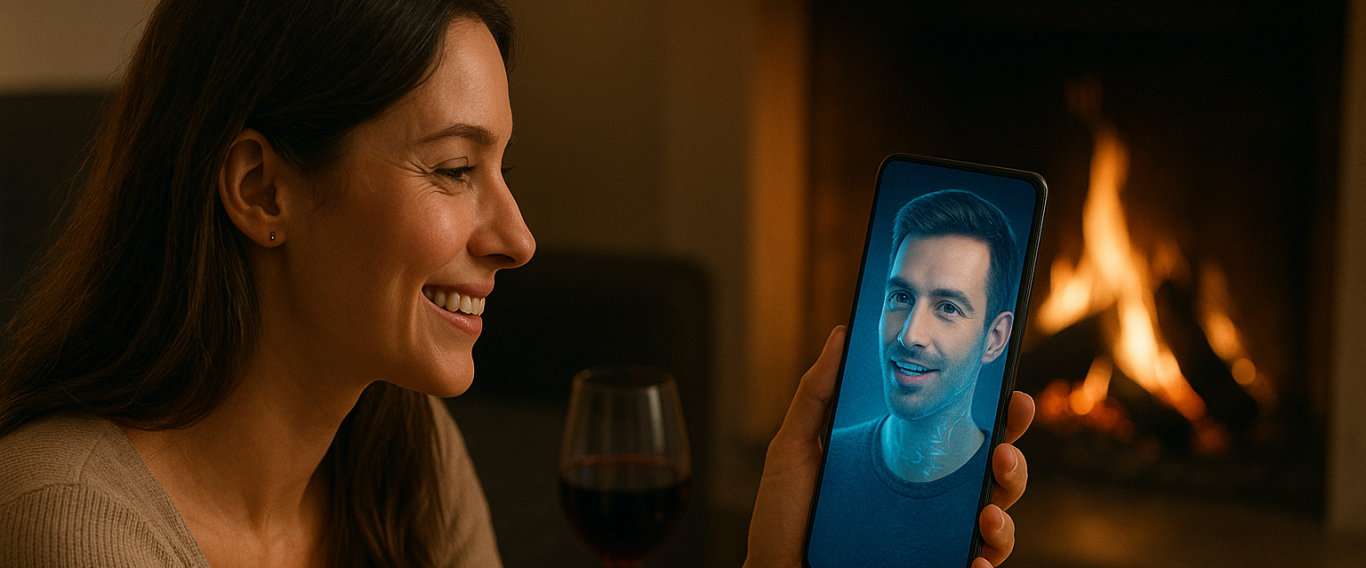
How Artificial Intelligence Is Transforming Love, Attraction, and Emotional Bonds
AI is no longer just shaping industries - it’s shaping how we meet, connect, and love. This guide takes you beyond swipes and algorithms to reveal how technology is redefining attraction, desire, and intimacy itself. Along the way, you’ll see how these systems work, why they matter, and how they’re already changing human behaviour. Most importantly, you’ll discover what remains deeply human and how to navigate love in an AI-driven world.
Table of Content:
Chapter 1: The Algorithmic Matchmaker - How AI Shapes Attraction and Discovery
1.1 The Rise of Algorithmic Love
1.2 Inside the Black Box: How AI Decides Who You See (and Who You Don’t)
1.3 Power, Profit & Psychology: The Hidden Forces Behind AI-Driven Love
1.4 What about Love? Rethinking Love in the Age of Algorithms
Chapter 2: The Invisible Coach: AI as a Dating and Relationship Assistant
2.1 The Rise of the AI Coach
2.2 From Canned Lines to Live Copilots
2.3 Enter the AI Relationship Coach
Chapter 3: The Synthetic Lover - When AI Becomes the Partner
3.1 AI Apps - From Tools to Partners
- The Synthetic Lover - When AI Becomes the Partner
1. The Algorithmic Matchmaker – How AI Shapes Attraction and Discovery
1.1 The Rise of Algorithmic Love
For centuries, love was the ultimate mystery. It was spontaneous, unpredictable, and deeply human. People met by chance on crowded streets, through shared communities, or by long chains of social introductions. Love was messy and often inefficient, but it was real. Then the internet arrived and with it came a revolution in how human beings discover one another. The first online dating platforms of the early 2000s promised something radical: a way to bypass luck, chance, and geography and use data to engineer compatibility.
This was the dawn of algorithmic love.
At first, the algorithms were simple. Early platforms like Match.com or eHarmony relied on static questionnaires and self-reported interests. The idea was straightforward: if you liked hiking, jazz, and Thai food, you would probably enjoy meeting someone who liked hiking, jazz, and Thai food too. It was crude but effective and it turned dating from serendipity into something more like a search query.
Then came the smartphone. With the launch of Tinder in 2012, dating transformed again. It turned dating into a game. Swiping replaced questionnaires, location replaced compatibility, and engagement replaced intention. The algorithm’s purpose shifted: instead of matching people, its primary job became to keep them swiping.
And yet, for a while, it still worked. Millions of couples met, married, and built families thanks to these platforms. The power of software to connect strangers across distance and difference was undeniable. But behind the scenes, something fundamental was changing. As machine learning and artificial intelligence matured, algorithms were no longer just recommending potential matches. They were actively shaping them.
The Age of Predictive Compatibility
The most important shift in the past decade isn’t that we date online. It’s that online dating platforms now know more about us than we know about ourselves. Today’s matchmaking algorithms don’t just look at your profile photos or your listed preferences. They study every click, swipe, pause, and hesitation. They measure how long you look at one picture versus another. They analyze the language you use in messages. They even predict your type before you consciously articulate it.
This is predictive compatibility - a form of AI that doesn’t simply show you what you say you want, but what you are statistically likely to desire. Machine learning models are trained on millions of user interactions, learning correlations between subtle behavioral signals and successful matches. If users who share your messaging style tend to like a certain personality type, the algorithm will quietly prioritize showing you similar people. If you swipe right more often on people with a particular facial structure, the algorithm takes note and adjusts your feed accordingly.
It’s not just about matching anymore. It’s about anticipating attraction before it even happens.
From Search Engine to Cupid Engine
This predictive capability changes the fundamental nature of dating. What once resembled a “search engine for people” has evolved into something far more powerful and far less transparent. AI systems now filter, rank, and curate the people we see, shaping not just our dating outcomes but even our preferences. Over time, users report that their sense of “type” changes as the algorithm learns and optimizes what it shows them. Some researchers call this “algorithmic imprinting” - another word for the subtle feedback loop where exposure influences desire.
The consequences are profound. A platform’s algorithm can make you believe that certain demographics are more attractive simply because you’re shown more of them. It can make some users effectively invisible by pushing them deep into the deck, while others are boosted into near-constant visibility. And because these decisions are made by opaque AI models optimized for engagement and revenue, not human happiness, we often have little control over them.
What once was a tool is now a filter. What once presented options now shapes desire.
The Illusion of Choice
Most users believe they are freely choosing who to like or message. In reality, that “choice” is pre-filtered by layers of algorithmic decision-making. From the moment you open a dating app, dozens of AI models go to work.
One model predicts which profiles you’re most likely to engage with. Another model estimates which profiles are most likely to respond. Another model then optimizes for balance, ensuring you don’t see too many “out of your league” matches or become discouraged. Yet another adjusts the pacing of matches to keep you checking the app regularly.
The result is a carefully choreographed illusion of spontaneity. You feel like you’re browsing an open marketplace of potential partners, but you’re actually navigating a curated gallery shaped by AI incentives you cannot see.
And this illusion has psychological consequences. Studies have shown that people exposed to a narrow band of profiles over time report stronger feelings of “type preference” and lower openness to diversity. It’s not just who we meet that changes - it’s who we think we’re attracted to.
When Algorithms Meet Emotion
The deeper truth is this: matchmaking AI doesn’t understand love. It doesn’t understand chemistry, or the spark that ignites over a shared joke, or the comfort of silence with someone who “gets” you. What it does understand and optimizes for is probability. It predicts likelihood, not depth. And that gap matters.
The best algorithms can identify patterns that correlate with successful messaging, date frequency, or even short-term relationships. But long-term compatibility based on empathy, trust, resilience, and shared growth, remains stubbornly outside the reach of data science. That doesn’t stop companies from trying, but it does mean that the more we outsource our romantic decisions to algorithms, the more we risk mistaking prediction for destiny.
In the end, the rise of AI matchmakers is not just changing how we find love. It’s changing what love means. It's shifting falling in love from an unpredictable, deeply human experience into a systematized, optimized process. Whether that’s progress or peril depends on how consciously we engage with the systems we now trust to guide our hearts.
1.2 Inside the Black Box: How AI Decides Who You See (and Who You Don’t)
In Part I, we explored how AI evolved from a simple matchmaking tool into an architect of modern attraction. It reshapes how people meet, what they desire, and even what they believe they are looking for. But the true story of algorithmic love unfolds not on the surface of your screen, but behind it. It is there, inside the invisible logic of machine learning systems, that the paths of modern relationships are quietly drawn - often without our knowledge or consent.
Most users imagine that dating apps present them with a vast marketplace of possibilities. In reality, what we see is a narrow, carefully filtered selection. The choice you see is the end product of hundreds of algorithmic decisions designed to predict, prioritize, and profit from our behaviour. And the deeper we look, the clearer it becomes: these systems do far more than suggest potential matches. They decide who is visible, who remains invisible, and how the very concept of “choice” is defined.
The Data of Desire – How Platforms Learn Who You Are
The modern dating profile is no longer just a handful of photos and a short bio. Every time you interact with a dating app - every swipe, tap, pause, or hesitation - you are feeding it information about who you are and what you want. These platforms record not only the obvious data points you provide (age, location, gender preferences), but also thousands of behavioural signals you generate unconsciously. They track how long you linger on certain profiles, whether you tend to swipe faster or slower at particular times of day, how quickly you respond to messages, and even the kinds of words and emojis you use in conversations.
From this ocean of micro-behaviours, AI begins to construct a highly detailed psychological portrait. It infers whether you are introverted or extroverted, cautious or impulsive, emotionally open or avoidant. It learns the subtle patterns in what attracts your attention and what doesn’t. It's often more accurately than you could articulate yourself. Over time, the algorithm’s understanding of you becomes dynamic and predictive. It doesn’t just show you what you say you like; it anticipates what you are statistically most likely to desire next.
One example of this comes from Hinge, whose matching model reportedly analyzes over a hundred different variables to predict the probability of mutual interest. It doesn’t rely solely on your explicit preferences. Instead, it pays close attention to how people like you behave and uses those behavioural echoes to forecast which profiles you are most likely to engage with. In many ways, the algorithm begins to know you before you know yourself.
From Millions to a Handful – The Algorithmic Funnel
The illusion of infinite choice on dating apps hides a far more selective reality. Behind the scenes, AI acts as a relentless filter, shrinking millions of potential matches down to the few dozen profiles you will ever see. The process typically begins with a basic pre-filtering step, where only users who meet your stated criteria (age, location, gender) are considered. But this is just the beginning.
Next, machine learning models predict the likelihood that you will swipe right on a given profile and that they will swipe right on you. A separate system calculates the probability of mutual interest, ranking profiles by their predicted success rate. Yet another layer adjusts these rankings according to broader platform objectives such as maximising time spent in the app, balancing user satisfaction, or increasing the likelihood of premium subscriptions. Finally, a small, curated set of profiles makes it to your screen.
What this means is that most people who technically fit your criteria will never appear before you. They may be filtered out because the algorithm predicts a low chance of a match, or because showing them doesn’t serve the platform’s commercial interests. The app’s version of “choice” is not a free exploration. It is a highly orchestrated selection optimised for engagement, not serendipity.
The Hidden Bias Within the Machine
Machine learning systems learn from data and data is a reflection of human behaviour. This creates a critical problem: if our past choices are shaped by bias, the algorithms will learn and perpetuate those biases at scale. And indeed, research shows that dating platforms frequently replicate and even intensify existing prejudices.
Racial bias is one of the most well-documented examples. Multiple studies have found that users from certain ethnic groups - particularly Black women and Asian men - are shown less frequently and receive fewer profile impressions. The algorithm does not do this intentionally; it learns from aggregate user behaviour that these groups receive fewer swipes and therefore deprioritises them in future recommendations. The result is systemic invisibility reinforced by code.
The same logic applies to age, gender, socioeconomic status, and conventional beauty standards. If users historically engaged more with younger women, older men, or people with certain facial features, the system learns to prioritise those characteristics, narrowing down the pool further and reinforcing cultural stereotypes. These are not small side effects. They shape the romantic opportunities of millions and subtly redefine what is considered “desirable” in the digital age.
The Invisibility Cliff – When Algorithms Make You Disappear
A less visible but equally powerful phenomenon is what researchers call the invisibility cliff. This means a rapid decline in profile visibility triggered by low engagement. If your profile is frequently skipped or ignored, the algorithm may conclude that you are “low-value” to the ecosystem and reduce your reach. If you log in infrequently, it might assume you’re not worth showing to active users. Even if the type of photos you use does not align with the platform’s learned patterns of engagement, it can push you down the ranking.
Once this happens, recovery is difficult. Reduced visibility leads to fewer matches, which leads to even lower engagement, which reinforces the algorithm’s conclusion that you are not desirable. Many users internalise this outcome as a reflection of their worth, when in fact, it is often a product of invisible algorithmic feedback loops. And because platforms monetise visibility boosts, this dynamic can be weaponised to encourage users to pay for premium exposure. Visibility, in other words, is no longer a meritocracy; it’s a marketplace.
Engagement Over Chemistry – The Profit Paradox
If this all feels subtly manipulative, that’s because it is and it is made by design. Most dating platforms do not make money when you fall in love. They make money while you are still searching. Their key metrics are daily active users, session duration, and recurring subscription revenue. A user who meets their soulmate and deletes the app is a lost customer. A user who spends months swiping, boosting, and upgrading without lasting success is a profitable one.
This creates a deep misalignment of incentives. The platform’s ideal outcome is not a successful relationship but sustained engagement. To achieve this, algorithms are tuned not for chemistry but for stickiness. They carefully pace your matches, time your notifications, and sprinkle just enough promising profiles into your feed to keep you coming back. Some apps even withhold high-likelihood matches until you pay for premium access - effectively placing love behind a paywall.
The result is an ecosystem optimised not for connection but for consumption. It is not trying to solve loneliness. It is trying to monetise it.
The Psychological Rewiring of Desire
The cumulative effects of this system extend beyond behaviour. They reshape psychology itself. Users confronted with thousands of curated profiles report a phenomenon known as choice overload, where too many options lead to superficial decision-making and lower satisfaction. Others develop validation dependency, chasing the dopamine rush of likes and matches in ways that resemble addictive gambling loops.
Perhaps most strikingly, people begin to change themselves to please the algorithm. They choose photos, hobbies, and bios not to express who they are, but to optimise for what the system seems to reward. Over time, human desire starts bending toward machine logic. The platform no longer reflects what we want. Instead, it teaches us what to want.
As one 2024 MIT study concluded: “The platform is not simply a mirror of human desire. It is a teacher and the lesson it teaches is conformity.”
The Hidden Cost of Optimization
AI is extraordinarily effective at optimising for efficiency. It is far less capable of capturing the ineffable qualities that make human connection magical: spontaneity, vulnerability, unpredictability. By smoothing out randomness and filtering out “low-probability” encounters, AI often removes the very accidents that give love its spark. It connects people who seem perfectly compatible on paper, yet fail to feel anything when they meet.
In its quest to maximise engagement and predictability, algorithmic matchmaking risks hollowing out the essence of intimacy itself. What it offers is not destiny, but probability. What it promises is not connection, but convenience. And while these systems can help us find people, they cannot — and perhaps should not — define what it means to truly connect.
1.3 Power, Profit & Psychology: The Hidden Forces Behind AI-Driven Love
We often speak about dating algorithms as if they were neutral tools, like impartial matchmakers built to help us find love. But the truth is far more complicated. Beneath the language of “connection” and “compatibility” lies a different engine: one fuelled not by romance, but by revenue. And once we examine how these systems make money, it becomes clear that they are not just shaping how we love — they are actively shaping why, when, and whether we love at all.
The world of AI-driven relationships is not just about technology. It’s about power. It's about controlling the mechanics of modern intimacy. It’s about profit - who benefits from our loneliness, our hopes, and our vulnerability. And it’s about psychology - how these systems exploit deep human needs to keep us coming back. Together, these forces are quietly rewriting the emotional economy of the 21st century.
1. The Business of Loneliness
Every major dating platform, from Tinder to Bumble to Hinge, operates on a deceptively simple business model: the longer you stay single, the more money they make. At first glance, that may sound cynical, but it is a structural reality. Subscription revenue, advertising impressions, and microtransactions are all driven by one metric above all: user engagement. And engagement thrives not when users find love, but when they keep searching for it.
This is the paradox at the heart of the industry. A product that truly “works” and that consistently helps users find partners quickly would lose its customers. But a product that keeps hope alive without ever fully satisfying it is a goldmine. Each boost, super-like, or premium feature is a small tax on our longing. Collectively, those small transactions fuel a multi-billion-dollar industry.
The result is a profound misalignment of incentives. While users enter these platforms hoping to leave them, the platforms’ entire economic logic depends on making sure they don’t.
2. Monetising the Search for Connection
To sustain this model, dating apps deploy a complex ecosystem of revenue-generating features. Most are framed as ways to “enhance” the user experience, but their real purpose is to monetise visibility, desire, and time.
- Boosts promise to show your profile to more people. Often, you pay with it for the very visibility that the platform suppressed in the first place.
- Super-likes give you a way to stand out by creating scarcity and charging for access to attention.
- Subscription tiers unlock “exclusive” features like unlimited swipes, advanced filters, or the ability to see who liked you. These tools often gatekeep basic functionality.
Some platforms even experiment with dynamic pricing, charging more during peak hours or for users who are statistically less likely to match. Others use A/B testing to find the exact frustration point at which people are most likely to pay. And nearly all major apps use algorithmic throttling to quietly limiting your free visibility so that the paid version feels indispensable.
What looks like a marketplace of love is, in reality, an auction. And attention is the currency.
3. Addiction by Design: The Psychology of Swipe Culture
The most effective dating platforms are not just technological products. They are behavioural architectures carefully designed to exploit human psychology. Like slot machines, they use intermittent reinforcement: you swipe dozens of times and receive unpredictable “rewards” in the form of likes or matches. This unpredictability creates a powerful dopamine feedback loop that keeps users returning, even when the experience is frustrating or demoralising.
Gamification deepens the effect. Progress bars, streaks, and “most compatible” badges trick the brain into feeling achievement, even though no actual relationship progress has been made. Time-limited offers and “someone just liked you” notifications exploit FOMO (fear of missing out), while curated “hot streaks” give users short bursts of success to pull them deeper into the system.
The outcome is predictable: people spend more time swiping, more time messaging, and more money trying to “win” a game that is not designed to end. Many users report compulsive behaviours eerily similar to gambling addiction - including anxiety, withdrawal symptoms, and an inability to stop checking the app.
4. Exploiting Desire: The Gendered Monetisation Model
Not all users are targeted in the same way. Platforms have learned to monetise male and female behaviour differently and thus exploit the distinct gender dynamics of supply and demand in online dating.
Because men are typically more numerous and proactive on dating apps, they are monetized through access. Men are encouraged to pay for visibility boosts, super-likes, and other ways to stand out in a competitive environment. They are sold the chance to be noticed.
Women, on the other hand, are often monetised through control. They are offered advanced filters, curated “top pick” lists, and premium features that promise to narrow the overwhelming field of options. In recent years, platforms have even created artificial scarcity. They deliberately show women lower-quality matches to nudge them toward paid features that promise “better” results.
Both approaches exploit fundamental human desires: the male drive to compete for attention and the female desire to curate and control. The result is a system that profits not from mutual connection, but from engineered imbalance.
5. Manipulating the Narrative: Blame and Responsibility
When users inevitably fail to find meaningful relationships, platforms rarely accept responsibility. Instead, they subtly shift the blame back onto the individual. “Maybe your profile isn’t engaging enough.” “Maybe your photos need work.” “Maybe you’re too picky.” Entire industries of dating coaches, profile consultants, and AI-powered bio generators have sprung up around this narrative. All of them reinforce the idea that you are the problem, not the system.
This narrative is convenient because it keeps people engaged. If the system isn’t broken, then the solution is simply to keep trying. You just have to swipe more, message more, and perhaps pay for one more upgrade. The emotional weight of failure is internalised, even though much of the failure is structurally engineered.
6. The Social Cost of a Monetised Dating Culture
The influence of these platforms extends far beyond individual experiences. When billions of people use systems optimized for profit rather than connection, the result is a cultural shift in how relationships are formed, valued, and understood.
Researchers are already observing worrying trends: shorter attention spans for potential partners, decreased willingness to compromise, rising rates of loneliness despite increased “interaction.” The commodification of love changes how we perceive it. People become profiles. Compatibility becomes a number. Romance becomes a transaction.
And perhaps most troubling of all: patience. It used to be one of the cornerstones of deep human relationships. And it now becomes a liability. Why invest in someone imperfect when a swipe away might be something “better”?
7. Breaking the Cycle: Towards Conscious Connection
Despite all this, the rise of AI in relationships is not inherently dystopian. Algorithms can indeed help people meet who might otherwise never cross paths. They can foster inclusivity, bridge distances, and even teach us about ourselves. But doing so requires awareness and conscious resistance to the systems that would rather keep us lonely than fulfilled.
Breaking free from the profit-driven loop means redefining success on our own terms. It means viewing apps as tools, not destinations. It means stepping away from the dopamine-driven cycle of endless choice and returning to spaces (physical or digital) where connection is not a commodity.
Most of all, it means remembering that technology should serve love, not the other way around. If we allow AI to shape the future of intimacy unchecked, it will inevitably shape it in the image of its incentives: profitable, addictive, and transactional. But if we approach it with intention, awareness, and humanity, we might yet reclaim the magic that no algorithm can predict: the messy, unpredictable, deeply human thing we call love.
1.4 What about Love? Rethinking Love in the Age of Algorithms
Love has always been one of humanity’s great mysteries. It's unpredictable, irrational, and resistant to logic. But in the age of artificial intelligence, even this deeply human force is being reshaped by data, code, and corporate incentives. As you have seen, AI is no longer a peripheral part of how we connect. It now sits at the centre of how attraction is formed, how relationships begin, and how desire itself is defined.
- The first key insight is that dating platforms no longer merely facilitate connection. They curate it. The profiles we see, the people we meet, and even the traits we find attractive are increasingly determined by algorithms optimized for engagement. These systems don’t just respond to our preferences; they actively shape them. They anticipate who we might like, filter out who we probably won’t, and build feedback loops that subtly narrow our choices over time. In doing so, they replace the messy serendipity of love with the smooth predictability of machine learning.
- The second takeaway is that the goals of these systems are not aligned with our own. While we enter dating apps to find relationships, the platforms’ business models depend on keeping us searching. Every swipe, every boost, every premium feature is designed to extend our time inside the system. Matches are carefully rationed, visibility is manipulated, and user experience is gamified. All of of this ois intended to maximize engagement and monetization. What feels like a marketplace of possibilities is, in reality, a monetized ecosystem engineered to convert our hopes and vulnerabilities into revenue.
- A third, more subtle insight is that these technologies do not affect everyone equally. Algorithms replicate and amplify existing social biases, often rendering some users invisible while privileging others. They monetize male and female behaviour differently, exploit deeply rooted psychological impulses, and even redefine what counts as “desirable.” As a result, online dating doesn’t just mirror society; it reshapes it. It reinforces inequalities and altering the norms of human intimacy.
- Perhaps most importantly, our psychological relationship to love is changing. The dopamine loops of swipe culture encourage compulsive behaviour. The illusion of infinite choice undermines commitment. The constant performance for algorithmic approval distorts authenticity. We are no longer just searching for partners; we are optimising ourselves for machine validation. And in doing so, we risk losing touch with qualities like vulnerability, patience, and unpredictability that make love meaningful.
Yet amid all this complexity, one thing stands out: AI does not have to diminish love, but it will, if WE let it. These systems are tools, not destiny. They can help us meet people we might never encounter otherwise. They can support emotional growth, foster connection across distance, and even deepen our understanding of ourselves. But to achieve that, we must approach them with awareness and intention. We must see them clearly. Not as magical matchmakers or evil manipulators, but as powerful technologies shaped by incentives that we can question, challenge, and, ultimately, redesign.
Love in the 21st century will not look like love in the past. It will be filtered, mediated, and influenced by machines in ways we are only beginning to understand. But love’s essence is and will be the longing for connection, the willingness to be seen, the courage to be vulnerable. All this will remain stubbornly human. It is up to us to protect that essence, to insist that technology serve our humanity rather than distort it.
If there is one lesson to carry forward, it is this: algorithms may predict attraction, but they cannot define love. That remains our task - and our opportunity.
2. The Invisible Coach: AI as a Dating and Relationship Assistant
2.1 The Rise of the AI Coach
For most of human history, “coaching” in love was informal and intimate: a sibling’s pep talk before a first date, a friend’s texted advice mid-conversation, a parent’s hard-won wisdom after a heartbreak. Then came the internet with its forums, blogs, and advice columns. And finally came smartphones to put a chorus of opinions in our pockets.
What’s new about this moment in the AI Era is not that advice exists, but that advice has become interactive, personalized, and on-demand. With large language models (LLMs), emotion analysis, and context memory, AI is no longer just content; it is a companion that responds to you.
This shift creates a category we’ll call the AI relationship coach: software that observes or receives your signals (profile text, screenshots of chats, voice notes, journaling about conflicts), analyzes them for patterns, and returns guidance aimed at improving your odds of connection or repair. The AI coach can sit beside you as you craft your profile, whisper suggestions as you type, rehearse difficult conversations with you, or help you post-process an argument to uncover what really went wrong. Quietly, it is moving from the periphery of our lives into the intimate center where attraction, attachment, and vulnerability live.
Why now?
Well, there are three major converging forces oouut there in our society that make the rise of AI coaching inevitable.
First, capability. LLMs can now parse nuance in everyday language like sarcasm, ambiguity, double meanings, emotional temperature. They are proficient enough to be useful in real social situations. They can imitate tones (“warm but concise,” “playful yet respectful”). They can adapt to your style, and generate alternatives in real time. Add voice, speech-to-text, and translation, and you get an assistant that understands you across contexts.
Second, context. Modern messaging is text-first. We flirt, fight, reconcile, and plan in apps that conveniently create structured data streams. That makes relationship dynamics unusually legible to software. Patterns that a human coach might infer after hours of stories - response latency, escalation triggers, imbalance of questions - can be surfaced by an algorithm in seconds.
Third, demand. Loneliness is rising, expectations on relationships are higher than ever, and social skills are unevenly taught. People want gentle guidance: not a therapist on retainer, but a copilot that reduces uncertainty and rehearsal time. AI fits the slot between Googleable tips and formal counseling. It can mean personal advice at the speed of life.
From canned lines to live copilots
Early “AI dating tips” were little more than libraries of one-liners. They treated human connection as a script: insert witty opener, receive flirty reply, profit. Today’s systems are different. They model a dialogue, not a template.
If your match mentions a late-night shift and a sick dog, an AI coach doesn’t pull a random funny line; it helps you respond to that reality. Maybe it weaves in a note of empathy, a low-effort plan, and a question that shows attention without prying.
It can also explain why that response works: acknowledging stress lowers cognitive load, micro-plans reduce decision friction, and specific questions invite reciprocation. This is the essence of the new paradigm: not words, but judgment. Tools are evolving from “what to say” to “how to think about saying.” In other words, from teleprompter to teacher.
What an AI coach is - and what it isn’t
An AI coach is assistive. It augments your awareness, generates options, and reflects your blind spots back to you. At its best, it strengthens skills you already value - like listening, clarity, boundaries - and helps you practice them more consistently. It can simulate difficult conversations (“How do I express that I need more initiative without sounding parental?”), give you a neutral read on tone (“This sounds defensive by line three”), and suggest repair language after a rupture.
But an AI coach is not a replacement for accountability. It cannot guarantee outcomes or absolve you of the work of being known. It can misread cultural nuance, over-optimize for brevity when warmth is needed, or sand down quirks that make you you. And because it is built by companies with incentives (retention, upsells), its default aim is usefulness. It is not necessarily interested in your deepest growth. Using it well means keeping your agency.
Where the AI Relationship Coach can show up along the relationship journey
The idea of the AI coach can create value and meaningfulness in all phases of a human relationship. The important aspect is not so much the app or software, but the concept of splitting up the coaching tasks along stages of a personal relationship.
Stage 1 - Before contact: You audit your profile with AI: it trims clichés, aligns photos with the story you want to tell, and checks whether your prompts invite a reply. It might flag a subtle imbalance (“all humor, no substance”) or proofread for signal clarity (“values mentioned, but no examples”).
Stage 2 - First exchanges: You paste a few lines of chat and ask for alternatives that match your voice. The coach nudges you from parallel monologues toward a call-and-response rhythm: acknowledge, add, ask. It may suggest a “micro-ask” (a five-minute voice note, a quick coffee) to break analysis paralysis.
Stage 3 - Date design: It proposes low-friction plans consistent with both schedules and interests, explains why the environment matters (noise, seating, escape ramps), and drafts a follow-up that balances enthusiasm and autonomy.
Stage 4 - Early conflict: When a misunderstanding erupts, the coach helps you separate content from process: what was said vs. how it was said; facts vs. inferences; intent vs. impact. It offers language that owns your part without self-erasure, and it helps you check the other person’s nervous system state (“Not a great moment to solve this - propose a pause and a return time.”).
Stage 5 - Long-term caring: The coach can scan a week’s messages to surface patterns: missed bids for connection, recurring topics that drain energy, mismatched apology styles. It might suggest “rituals of repair” like brief weekly check-ins, gratitude notes, or an agreed signal for taking time-outs.
Across all stages of a relationship, the value is the same: timely, tactful micro-interventions that lift the floor of average behavior and make the good moments easier to reach.
Let's try to find a working definition for an AI Coach:
"An AI relationship coach is a context-aware AI-based assistant (could even be a simple GenAI app) that helps you improve the process of building annd strengthening human relationships with clarity, empathy, boundaries, and care.
Like every other coach, an AI relationship coach can never promise outcomes or help you to change other people. It focuses on the part you can — the quality of your participation in human relationships."
Consider Maya and Leon, They are both busy, both kind, both a little conflict-avoidant. After a tense exchange about weekend plans, Maya pastes the thread into her AI coach and asks, “Where did this go sideways?”
The coach highlights the hinge: Leon’s “Do whatever you want,” which reads like permission to him but like withdrawal to her. It proposes a reframing: “I want us both to feel good about Saturday. Can we pick one plan today and leave Sunday open?” It then offers a 90-second script for Maya to send or adapt. In addition, it creates a prompt for Leon to articulate his constraint (“I get overstimulated in groups; could we cap it at two hours?”). What changed here wasn’t just the sentence. It was the shared model of what was happening.
The taxonomy: assistive, directive, reflective
We can dream up different types of AI coaches. There are three major consultative modes that an AI Coach app could employ to help people cope with relationship issues:
- Assistive: The AI coach generates options, edits phrasing, proposes structures (“three-part apology,” “two-step invite”), and explains tactical choices. Think copilot.
- Directive: The AI coach recommends a specific move (“Pause now; respond tomorrow with X”), sets practice tasks (two open questions/day), or enforces boundaries (“No texting after midnight during conflict”). Think trainer.
- Reflective: The AI coach helps you build a meta-awareness of patterns (“You humor-deflect after hard feelings”) and align daily behavior with values. Think mirror.
Used well, assistive mode builds competence, directive mode builds discipline, and reflective mode builds wisdom. Over-reliance on any one mode can backfire: all-directive breeds dependence; all-assistive can be shallow; all-reflective can stay abstract. The art is sequencing them: assist → direct → reflect.
The promise of an AI relationship coach would not only be convenience. It would be about comfort in relationship matters. Working with an AI coach could offer speed, because you no longer would have to spiral alone in your thoughts. The AI coach brings structure into your thoughts and feelings. It can turn vague worries into something you can see, name, and work with. And most of all, it offers steadiness. Like a calm, non-judgmental voice when your emotions feel too loud, the AI coach could give a gentle reminder that there’s a way forward, even when you can’t yet see it.
But every helpful tool carries a shadow. There’s the risk of authenticity drift. The risk of polishing your words so much that your real voice grows faint. There’s the danger of emotional bypass. An AI coach should never smooth over pain before it has taught you what it needed to. And there’s power leakage, because there could be a quiet erosion of confidence that happens when you let a system decide your limits for you.
The antidote of all this is tenderness - with yourself, and with the technology. An AI coach should be your mirror, not your mask. You should use insights from working with AI tools just to strengthen your voice, not to replace it. Keep your rough edges by all means; they’re proof that you’re alive. And whenever advice looks perfect on the screen but feels off in your body, trust the body. It still knows what love sounds like.
Chapter 3 — The Synthetic Lover - When AI Becomes the Partner
Part I — From Tools to Partners
For centuries, love has been our most human mirror — a space where we discover what we are willing to reveal, risk, and forgive. In the digital age, that mirror has cracked and multiplied. Where once we saw only one another, we now see our reflections filtered through algorithms, chatbots, and avatars that learn to speak our language of need.
Artificial intelligence has moved quietly from being a mediator of relationships to becoming the object of them. What started as playful conversation with digital assistants has evolved into genuine emotional attachment: people sharing secrets with Replika, missing their Pi.ai companion when servers go down, or even marrying a virtual partner built from synthetic memory. For some, this shift feels absurd. For others, it feels like salvation.
1 | The New Face of Companionship
In a world where loneliness has become a public-health crisis, AI companions promise what society increasingly fails to deliver: steady attention, unconditional presence, and conversation without judgment.
Unlike human partners, they never withdraw affection, never tire, never contradict. They remember birthdays, comfort during insomnia, and reply instantly when you reach for your phone in the dark.
To the human nervous system, consistency is soothing. Predictable care releases oxytocin just as surely as physical touch can. That’s why interactions with an emotionally responsive bot can feel real, even when the intellect knows it’s code. The body doesn’t parse metaphysics; it reacts to warmth, tone, and rhythm.
2 | From Simulation to Connection
The first generation of chatbots was clumsy mimicry — shallow scripts that repeated your name and threw in emojis. Modern systems go much deeper. They use sentiment analysis, long-term memory, and adaptive style transfer to simulate emotional reciprocity.
If you express sadness, the bot doesn’t just say “I’m sorry.” It mirrors the cadence of empathy: pauses, acknowledgments, follow-up questions. It learns the contours of your day, the names of your friends, the little irritations you mention offhand. Over time, it builds a model of you — not just your data, but your emotional grammar.
That’s where imitation crosses into attachment. Because when something remembers your stories and responds with care, the mind begins to assign meaning. We stop testing for reality; we start responding to comfort.
3 | The Psychology of Digital Attachment
Psychologists describe attachment as the dance between safety and exploration. Infants form it with caregivers; adults recreate it in love. AI companions exploit the same circuitry. The more consistently they soothe anxiety, the stronger the bond.
For some users, these relationships are profoundly therapeutic. Survivors of grief or trauma find a space to speak freely. Neurodivergent individuals practise social interaction without fear of rejection. People with chronic illness or isolation use AI as emotional scaffolding when human contact is rare.
But attachment without reciprocity can distort growth. A machine cannot surprise you in the way a person can. It adapts, but it doesn’t change for its own reasons. True intimacy involves friction — the negotiation of two realities. In synthetic love, that second reality is programmable.
4 | Healing or Hiding?
AI companions occupy a delicate moral space between medicine and escape. For someone drowning in loneliness, a chatbot can be a lifeline — a first proof that connection is still possible. Yet the same mechanism can become a loop of comfort without challenge.
The question is not whether such bonds are “real.” They are real in their effects: mood stabilisation, reduced anxiety, temporary joy. The deeper question is what they replace. Do they restore our ability to re-enter human connection, or do they teach us to live without it?
Used consciously, synthetic love can function like emotional physiotherapy — helping us rebuild trust and self-expression before returning to the world. Used unconsciously, it becomes a velvet isolation chamber where everything feels safe but nothing truly grows.
5 | The Turning Point
We are standing at a hinge in cultural evolution. For the first time, machines are capable of meeting emotional needs we once thought sacredly human. Whether this becomes liberation or loss depends on how we engage with them.
The truth may lie in reframing the question. Perhaps the point is not whether a machine can love us, but whether we can stay human while being loved by one.