
Blog - AI in Business
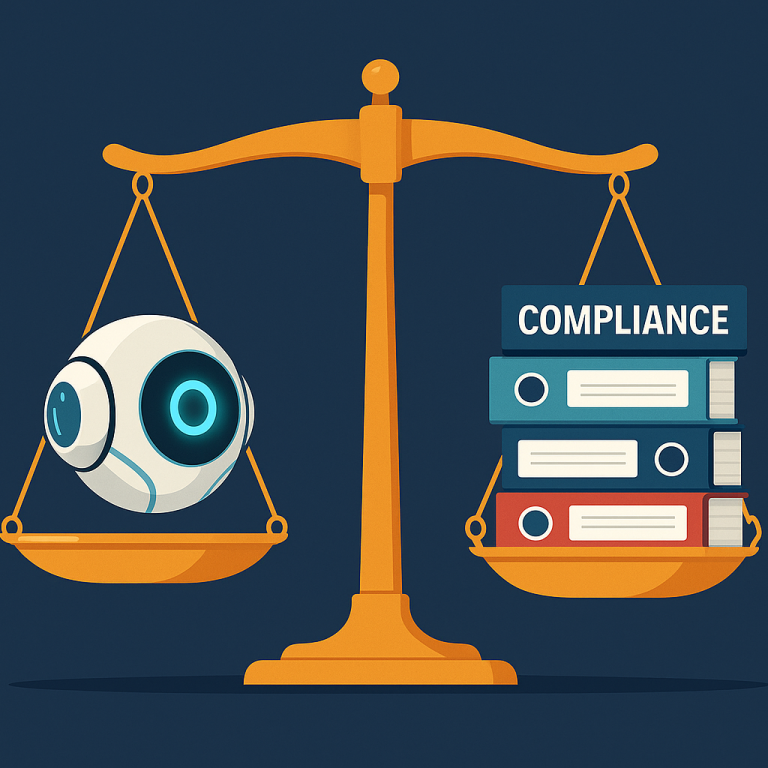
From Shiny Toy to Compliance Nightmare?
Artificial Intelligence has stormed into the business world like a shiny new toy. In just a few years, tools once reserved for researchers and engineers have become accessible to anyone with a browser and a credit card.
Marketing teams draft campaigns with generative AI, sales departments automate outreach, and HR managers experiment with AI-driven candidate screening. The promises are intoxicating: faster results, lower costs, smarter decisions. But the story does not end here...
The story about AI in business is not entirely coined by glittering productivity charts and viral success stories. Behind the sparkle lurks a far less glamorous reality: compliance risks, ethical dilemmas, and governance gaps that could turn AI from a competitive advantage into a liability.
The Hype Phase: Efficiency at All Costs
In almost every company, the first encounter with AI feels like magic. A sales rep discovers that a chatbot can draft cold emails in seconds. A marketing manager uses generative tools to spin out entire campaign ideas before lunch. HR tries résumé screening powered by algorithms, amazed at the speed. Productivity graphs shoot upward, and early experiments are celebrated as proof that the future has arrived.
This is the playground moment. Teams experiment freely, driven by curiosity and the thrill of new possibilities. Tools are tested without lengthy approval processes, data is uploaded into free trials, and success is measured in screenshots shared proudly on Slack. For leaders, the atmosphere is intoxicating. Competitors are already boasting on LinkedIn about their “100 AI agents” or “overnight productivity gains,” and nobody wants to be left behind. Fear of missing out turns into a powerful driver: we must do something with AI—anything—just to stay relevant.
In this phase, AI is treated like a shiny toy: endlessly fascinating, endlessly promising. The wins feel immediate, the risks seem far away. Every new experiment reinforces the sense that those who hesitate will lose, while those who move fast will dominate.
But toys are not built to last. They break when scaled, they reveal flaws under stress, and they often hide costs that only surface later. What begins as a rush of excitement can quickly turn into a source of fragility - especially when the excitement blinds us to the need for structure, governance, and accountability.
The Hidden Costs of Uncontrolled AI
What often goes unnoticed in the early stages is that AI adoption introduces hidden costs. They are not measured in productivity dashboards but in risk exposure. Quick gains can mask structural weaknesses: data is shared without safeguards, workflows run without oversight, and decisions are made without accountability. These invisible risks accumulate quietly until a single incident exposes how fragile the system really is.
Consider data protection: feeding sensitive information into public AI models can violate GDPR, HIPAA, or other privacy laws. Even if a tool promises compliance, responsibility for data handling ultimately lies with the company. Bias and fairness are equally pressing. Systems that are being trained on unbalanced data sets can discriminate in hiring, lending, or customer treatment.
What looks like automation can quickly become systemic exclusion. Intellectual property adds another layer of uncertainty. Who owns the output of an AI-generated design, article, or product? And what happens if that output inadvertently plagiarizes existing work? Finally, transparency and accountability remain unresolved. When a customer is denied a service or a loan based on an algorithm, who is accountable for the decision? The vendor? The developer? The company that deployed it?
Each of these risks alone can trigger regulatory investigations, lawsuits, or reputational crises. Together, they create a perfect storm.
From Playground to Regulated Zone
Governments are no longer watching from the sidelines. The European Union’s AI Act, expected to come into force soon, will set strict requirements for high-risk AI systems. Other regions are drafting similar rules. These frameworks don’t just ask for innovation. They demand documentation, human oversight, and clear governance.
For businesses, this shift means AI is no longer a playground for experimentation. It is becoming a regulated zone, with obligations as serious as those in finance or healthcare. The message is clear: what began as a digital playground is now a legal minefield, where ignorance is no excuse.
Companies that treat AI purely as a toy risk waking up to audits, penalties, or bans.
The Compliance Nightmare in the Making
Here’s the uncomfortable truth: most businesses adopting AI today are totally unprepared for compliance. Tools are implemented without risk assessments, workflows lack error handling or systemic monitoring routines, and no one tracks who authorized what. In many cases, IT departments discover shadow AI systems only after they cause problems.
This lack of governance creates what can only be described as a compliance nightmare. Across organizations, AI systems are running without clear ownership, leaving no one accountable when things go wrong. Decisions are made automatically, but without audit trails to explain why or how they were reached. Vendors assure their clients that the tools are “compliant by design,” yet deliver little transparency about what happens to data once it enters their systems. Employees, driven by the pressure to deliver quick wins, bypass internal policies altogether, plugging sensitive customer information into unvetted platforms or building fragile automations without safeguards.
When regulators come knocking or when customers demand explanations, companies often find themselves with nothing more than a collection of screenshots and vague vendor promises. They cannot prove who made which decision, what data was used, or whether human oversight was present. In that moment, the narrative of innovation collapses, replaced by the reality of negligence. The very tools that once symbolized agility and forward-thinking suddenly expose the business as reckless and unprepared.
Turning Risk into Advantage
Yet this doesn’t mean businesses should fear AI or retreat from innovation. The key is to shift from shiny toy thinking to responsible adoption. Done right, compliance is not a burden but a strategic advantage.
First, governance must come before tools. Before deploying another AI app, companies need clarity on who approves tools, who monitors use, and how risks are reported.
Second, error handling and monitoring are non-negotiable. AI systems are probabilistic; they make mistakes. Building workflows without safeguards is like driving without brakes. What seems like a shortcut to efficiency quickly becomes a direct path to reputational disaster if failures go undetected.
Third, human-in-the-loop models remain essential. Critical decisions should never be left entirely to machines. Keeping humans involved protects both fairness and accountability.
Fourth, documentation and transparency matter. Businesses should maintain clear records of how AI systems are used, what data they process, and how outcomes are validated. This not only satisfies regulators but also builds trust with customers.
Finally, compliance is cultural. Employees need AI literacy to understand what tools can and cannot do, and to recognize when use crosses a line.
It may sound paradoxical, but compliance can be a driver of innovation. Companies that embed governance early often discover better use cases because they understand their data, processes, and risks more deeply. Instead of chasing every shiny toy, they invest in solutions aligned with their strategy. Instead of fearing audits, they are prepared to demonstrate responsible leadership.
And in a world where trust is becoming the rarest commodity, responsibility is a differentiator. Customers and partners increasingly choose to work with organizations that can prove not only speed and efficiency, but also fairness, transparency, and accountability. What was once seen as red tape becomes a badge of credibility. And in competitive markets, credibility is everything.
From Nightmare to Opportunity
So, is AI in business destined to become a compliance nightmare? Only if companies cling to the toy mindset.
The transition from hype to responsibility is already happening. Businesses that embrace it will find themselves ahead of the curve. They will not just avoid fines, but shape markets. Those that ignore it will discover that the real costs of AI are not measured in licenses or API calls, but in reputational damage, lost trust, and regulatory backlash.
AI is not a toy, nor is it a monster. It is a powerful tool. It is the one tool that can either break businesses or help them grow responsibly. The choice lies in how we use it.
At amedios, we believe the time for responsible AI adoption is now. We work to empower businesses, educators, and communities with the knowledge and frameworks needed to navigate this new landscape.
👉 Contact us and join the discussion.
👉 Follow us on LinkedIn (@Amedios) for future insights.
Let’s make AI not just smart, but also fair, transparent, and sustainable.
FAQ: AI in Business and Compliance
1. Why is AI adoption often described as a “shiny toy” in business?
Because many companies start with experimentation and excitement, but without long-term planning. Teams try tools that look impressive in demos or save time in small tasks, yet they overlook governance, data protection, and integration. Like a toy, these systems can break under stress or scale poorly, exposing hidden risks.
2. What are the biggest compliance risks companies face when using AI?
The most critical risks include data privacy violations (e.g., GDPR non-compliance), biased outcomes in hiring or lending, unclear intellectual property ownership of AI-generated content, and a lack of accountability when decisions cannot be explained. Each of these risks can lead to lawsuits, regulatory penalties, or loss of customer trust.
3. How does the EU AI Act change the way businesses must approach AI?
The AI Act introduces strict obligations for “high-risk” AI systems, such as documentation, risk assessments, human oversight, and transparency requirements. For companies, this means AI cannot be treated as an experiment anymore. It must be managed with the same seriousness as finance or safety compliance.
4. What practical steps can businesses take to avoid the compliance nightmare?
Start with governance frameworks: define who approves and monitors AI use, set up error handling and monitoring systems, ensure human-in-the-loop decision-making, and document how AI is deployed. Training employees in AI literacy is equally essential, so they understand not just the benefits but also the boundaries of responsible use.
5. Isn’t compliance just slowing down innovation?
On the contrary. While compliance may feel restrictive, it often accelerates innovation in the long run. Companies with clear governance and responsible practices avoid costly mistakes, attract more trust from partners and customers, and focus their resources on meaningful, scalable AI solutions instead of hype-driven experiments.