
Blog - AI in Education
Why a Post-Education Society Would Be the Fast Lane to Idiocracy
If machines can already write essays, solve equations, and summarize entire libraries, why bother with schools, universities, or even learning to read?
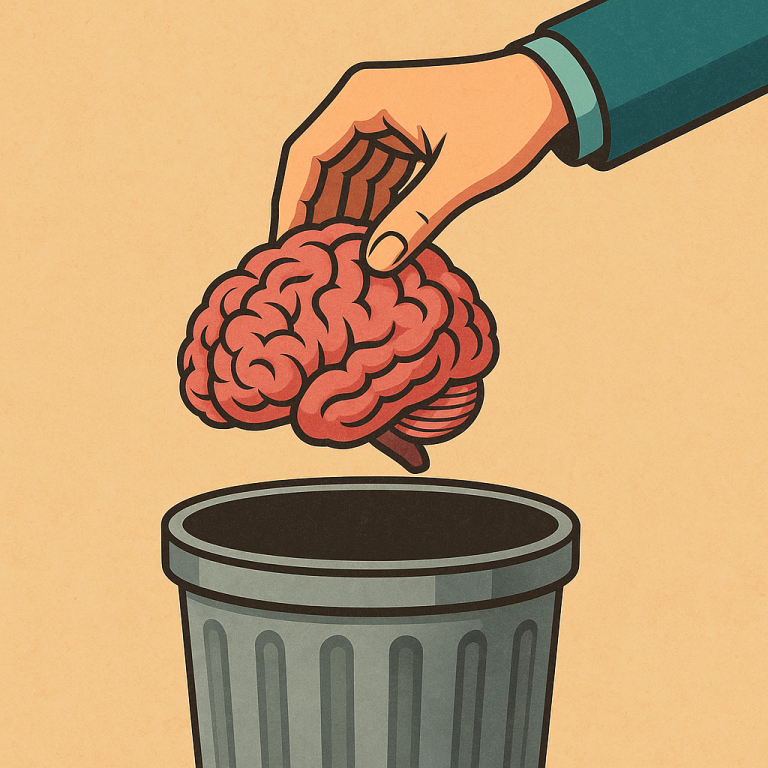
Some now claim education is obsolete in the age of AI. But without literacy, critical thinking, and moral judgment, humanity won’t be liberated by AI - it will be infantilized, trapped in digital dependency, and marching straight toward idiocracy.
It sounds almost absurd, yet these discussions are very real. From The Guardian to The New York Times, headlines have asked: Do children in the 21st century still need to learn how to read and write? Others posed equally provocative questions: Is a university degree already obsolete? And now, in an era when artificial intelligence can generate essays, perform calculations, and summarize entire libraries in seconds, some even wonder: Why cling to an education system at all, if machines can take over every intellectual task once considered the hallmark of humanity?
Such suggestions are less visionary than reckless. They reveal a dangerous fascination with convenience - an eagerness to outsource not only physical but also intellectual labor. Comfort is confused with progress. And make no mistake: a society that treats education as dispensable is not entering a golden age. It is rushing headlong into a modern form of Idiocracy - a 2006 satire that depicts a future where the neglect of education and critical thought has left humanity stupefied and dependent. It was intended as a warning, not as a blueprint.
The Allure of Outsourced Thinking
At first glance, the idea has its charm. Why endure grammar drills, mathematical proofs, or philosophy seminars when a chatbot can instantly provide polished answers? In this seductive narrative, education becomes a relic of the analog age, a tedious ritual of the past.
But follow the logic through: a generation unable to construct a coherent argument, distinguish fact from fabrication, or grapple with numbers and historical context would not be liberated - it would be disarmed.
Research on automation bias shows how readily people defer to machine outputs when they no longer trust their own judgment (Parasuraman & Riley, 1997, Human Factors). The results are visible not only in aviation and medicine but increasingly in daily life, where algorithmic decisions are accepted as objective truth simply because they appear machine-made.
The Limits of the Machine
Artificial intelligence is indeed a monumental achievement. It accelerates scientific research, supports medical diagnoses, optimizes logistics, and even produces prose that passes for human writing. It is efficient, tireless, and dazzlingly powerful - but it is not wise.
Algorithms cannot feel responsibility, make moral distinctions, or judge whether an action is socially constructive or destructive. That task remains ours. Education is the scaffolding that enables people to step back, evaluate, and ask: Should this be done? Without that scaffolding, AI ceases to be a tool and becomes a black box with a cult following.
As Inside Higher Ed observed in its essay Teaching Writing in the Age of AI, genuine writing goes far beyond technical proficiency. It requires responsibility, an awareness of audience, a distinctive personal voice, and, above all, critical thinking - dimensions that AI, at least for now, cannot replicate.
The Consequences of Forgetting Education
Consider the practical implications of a “post-education” society. A system glitch, a blackout, or a malicious cyberattack - and the smooth machine-run order collapses. If no one understands how to intervene, repair, or even interpret what went wrong, the result is paralysis. Progress degenerates into helplessness.
The European Commission’s White Paper on Artificial Intelligence (2020) makes this point explicitly: without human oversight and competence, AI becomes a liability rather than an asset. Declaring education obsolete today is like throwing away the flight manual because the autopilot seems reliable.
Education as the Last Line of Defense
Education is not nostalgic ballast from a bygone era. It is the condition for sovereignty in a digital world. Reading and writing are not decorative skills; they are survival skills in an environment flooded with both information and misinformation. Mathematical literacy is not an academic luxury; it is what enables people to spot a misleading statistic or a manipulated graph. Critical thinking is not a soft skill; it is the firewall against intellectual dependency.
UNESCO’s 2021 Futures of Education report put it succinctly: “Education is humanity’s greatest renewable resource.” To imagine that this resource could be discarded simply because machines exist is to misunderstand both machines and humans.
The foundations remain the same
The defining question of the 21st century is therefore not whether education is still needed, but which education is indispensable. The foundations remain the same: literacy, numeracy, historical awareness, logical reasoning. But to these must be added new literacies - data, media, and ethics. We must teach not only how to use machines but also how to resist them when their output is flawed, biased, or dangerous.
Without these capacities, the promise of artificial intelligence becomes a trap. It will not elevate humanity but infantilize it, producing a society unable to tell the difference between genuine knowledge and statistical guesswork.
Believing that education is obsolete because machines are fast is to mistake speed for wisdom. A “post-education” society would not be innovative; it would be incapacitated. The true danger is not that machines will outthink us, but that we will stop thinking altogether.
So the question must be reframed. Not Do we still need education? but How must education be reinvented to preserve human sovereignty in the age of AI?
Because without education there can be no control, no responsibility, and ultimately no progress - only dependence, dressed in digital brilliance. When the machines make mistakes - and they will - who will be left to notice, if not us?