
Blog - AI in Business
The AI Agent Gold Rush: Why 18-Year-Olds on LinkedIn Won’t Make You Rich
AI agents are making headlines as the next big thing in business automation.
But beneath the hype, critical flaws and compliance risks raise the question: are these agents truly a breakthrough — or just another passing trend?
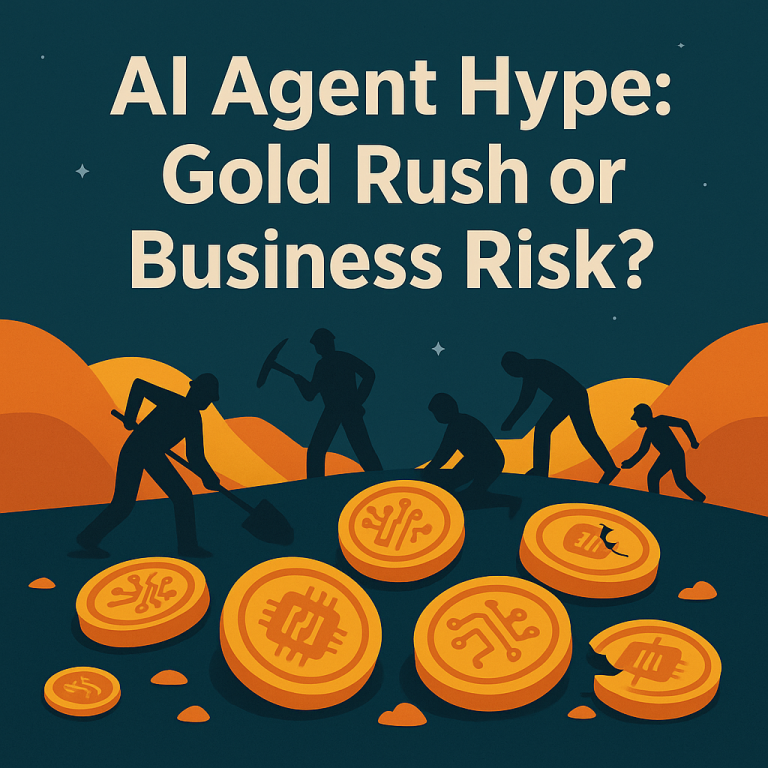
Every gold rush begins with a promise: instant fortune for those brave enough to seize the moment. In the mid-1800s, people rushed to California with picks and pans, convinced that nuggets of gold lay waiting to be scooped from the riverbed. Few found riches. Many were left with broken dreams. The ones who profited most were those who sold the shovels.
Fast-forward to LinkedIn in 2025, and the scene looks strikingly similar. Instead of picks and pans, we see polished graphics of futuristic AI agents. Instead of riverbeds, there are no-code platforms and flashy demos. And instead of nuggets, the promise is “100 AI Agents in one hour—download now, and you too can be rich and successful.”
But just like in the historic gold rush, the majority who rush in with hope will find little of value.
The Gold Rush on LinkedIn
If you scroll through LinkedIn today, you’ve probably seen the pattern. A young entrepreneur posts a shiny image of AI agents with sci-fi avatars and glowing interfaces. The caption follows a predictable script: “I built 100 AI agents that work for me around the clock. They make me money while I sleep. Comment ‘AGENT’ and I’ll share my free template with you.”
The formula works. Hundreds comment, thousands like, and the post spreads like wildfire. Some genuinely hope this is the shortcut to wealth. Others simply don’t want to miss out. The hype feeds itself.
And why wouldn’t it? Who doesn’t want an army of digital workers running tasks, scaling business, and generating income automatically? It’s the dream of frictionless entrepreneurship, packaged in a way that looks as if it can be achieved in an afternoon.
What’s Behind the AI Agent Hype?
At its core, the AI agent craze rests on the idea that you can combine large language models (like GPT) with workflow automation platforms (like n8n, LangChain, or AutoGPT) to create self-running digital workers. Each “agent” is supposed to take a tas, like sending an email, scraping a website, summarizing a report, or scheduling meetings - and execute it without human intervention.
In theory, it sounds revolutionary. In practice, most of these “100 agents” are little more than copy-paste workflows connected to public APIs. They often work once for the demo, under ideal conditions, but collapse the moment they face real-world business complexity.
The viral posts rarely show this reality. They present the idea, not the execution. And that’s why so many people fall for it.
The Hidden Flaws of One-Click AI Agents
Why do most of these agents fail in practice? Because they are designed for hype, not for business reality.
First, they lack error handling. When an API call fails, the workflow simply stops, leaving tasks unfinished and no one the wiser. In a demo, this doesn’t matter; in a live business process, it can be catastrophic.
Second, they lack monitoring. In real operations, you need dashboards, alerts, and logs to know whether your automations are actually running. Viral AI agents offer none of this. They are black boxes that either run silently or break silently.
Third, they lack business integration. Real companies don’t operate in isolation. They have CRMs, ERPs, compliance systems, and specific workflows. A generic “AI agent template” doesn’t align with these processes. The result: automations that look impressive but can’t be implemented without major rework.
In short: most viral AI agents are pretty demos. They look good in a LinkedIn post. They don’t hold up under the weight of actual business needs.
Why Businesses Fall for It
If the flaws are so obvious, why do businesses - and individuals - still fall for the AI agent hype?
Part of the answer is FOMO: the fear of missing out. Nobody wants to be the manager who ignored AI while competitors moved ahead.
Part is social proof. When a post racks up thousands of likes and comments, it feels legitimate. The crowd can’t all be wrong, can it?
And part is the desire for shortcuts. Building robust AI systems is hard work. It requires governance, integration, and deep process understanding. The promise of skipping all that with a download link is almost irresistible.
Underlying all of this is a deeper issue: a lack of AI literacy. Many decision-makers can’t evaluate whether an AI workflow is robust or fragile. They see speed and novelty but don’t know how to assess error handling, compliance, or scalability. That knowledge gap creates fertile ground for hype.
And it’s not only the tools that are immature - it’s often the people who build them. Many of the viral agent templates are created by individuals with limited technical depth and virtually no business experience.
They may know how to chain together APIs or generate code snippets with ChatGPT, but they have never run a compliance audit, optimized a KPI, or designed a customer journey. Expecting such solutions to transform a company is like expecting a student pilot to fly a commercial airliner.
From Toy to Tool: What Real AI Agents Need
When businesses first encounter AI agents, the temptation is strong to be impressed by the shiny interface or the promise of “100 agents in one hour.” But whether you are a manager considering to buy such solutions, or an entrepreneur eager to implement them, the real question is: will these agents actually work in your business environment? Most viral demos collapse once they leave the safe space of a LinkedIn post and face the messy realities of data, processes, and compliance.
That is why it is essential to know what separates a toy from a tool. Before investing time, money, or trust, ask whether the solution you are considering meets a handful of basic but critical criteria. These criteria are not about hype or aesthetics - they are about stability, responsibility, and true business value. If you keep them in mind, you will be far better equipped to separate fragile experiments from reliable systems.
(1) Clean, structured data.
Every AI agent is only as good as the information it works with. If the data is messy, incomplete, or biased, the agent will replicate those flaws at scale. Clean, structured, and well-governed data is the foundation that allows agents to deliver consistent value rather than inconsistent noise. Without it, the promise of efficiency quickly turns into a cycle of correcting errors and mistrust in the system.
(2) Scalable architecture.
One-off workflows may look impressive in a demo, but businesses need solutions that scale without breaking. A scalable architecture ensures that agents can handle larger volumes of tasks, adapt to new inputs, and function reliably across departments. This requires thoughtful design, not quick hacks. Without scalability, what looks like an innovation quickly becomes another bottleneck.
(3) Monitoring and logging.
In a live business environment, leaders need to know when things go wrong, why they went wrong, and how to fix them. Proper monitoring and logging provide that visibility. Without dashboards, alerts, and traceability, companies are effectively flying blind. They are unable to spot errors until customers complain. Monitoring is not a nice-to-have; it is the safety net that keeps AI agents from becoming silent saboteurs.
(4) Governance and compliance.
AI agents are not just technical systems; they operate in a regulated, ethical, and social environment. Governance ensures that agents respect data privacy, avoid discriminatory practices, and remain aligned with company policies. Compliance frameworks add accountability, showing regulators and stakeholders that AI is being used responsibly. Without governance, businesses invite legal trouble and erode trust with every interaction.
(5) Integration with core systems.
Finally, AI agents must work within the real ecosystem of a business. A sales agent that doesn’t talk to the CRM, or a finance bot that can’t connect with ERP systems, is a toy at best. True integration ensures that agents don’t just perform isolated tasks but contribute meaningfully to end-to-end processes. Only then do they stop being gimmicks and start delivering genuine business value.
(6) Trusted expertise.
And perhaps most importantly: no AI agent is better than the expertise of the person or team who builds it. If you wouldn’t trust someone to design your business processes, you shouldn’t trust them to automate them with AI. Creating agents that are compliant, resilient, and truly valuable requires not only technical skill but also deep understanding of organizational dynamics, KPIs, and customer expectations. Without that maturity, even the cleverest code remains a toy—and relying on it can put your company at risk.
Beyond the Gold Rush
So where does this leave us? AI agents are not scams. They are not snake oil. They are a field with enormous potential. But the way they are currently hyped on LinkedIn does businesses a disservice. By overselling the dream and ignoring the reality, these posts risk creating disillusionment when expectations inevitably collapse.
The lesson from the historic gold rush applies here: the real value doesn’t lie in chasing shortcuts or shiny tools. It lies in the systems, processes, and infrastructure that support sustainable growth. In AI, that means literacy, governance, and strategic integration.
For businesses, the smartest move is not to download “100 AI agents” from LinkedIn. It is to build the knowledge and frameworks that let them separate the toys from the tools - and then invest in solutions that actually deliver.
Conclusion
The AI agent gold rush is here, and like every rush before it, it is filled with both opportunity and illusion. Some will strike gold, but many more will waste time and resources chasing promises that were never real.
The winners won’t be those who download the most templates. They’ll be the ones who understand the risks, who build with quality and compliance in mind, and who see through the hype to the hard work of real transformation.
In other words: don’t be dazzled by the toys. Build the tools. That’s where the real wealth lies.
Join the Conversation
At Amedios, we believe in empowering businesses to cut through the hype and focus on responsible, sustainable AI adoption.
👉 Read our Definitive Online Guide: "AI in Business - Unlocking Competitive Advantage through Smart AI-Adoption".
👉 Follow us on LinkedIn (@Amedios) for future insights.
Together, we can make AI not just exciting, but effective.
FAQ: AI Agents in Business
1. What exactly is an AI agent?
An AI agent is a software system that uses artificial intelligence to perform tasks autonomously, often combining a large language model (like GPT) with automation tools (such as n8n or LangChain). In theory, agents can handle repetitive work - like drafting emails, summarizing documents, or updating CRM records—without human intervention. In practice, however, most require careful setup, monitoring, and integration to be reliable.
2. Why are so many “AI agent templates” on LinkedIn problematic?
Most viral agent templates are designed for hype, not for business reality. They often lack error handling, monitoring, or compliance safeguards. They may run once in a demo but collapse in real-world conditions. And importantly, many are built by people with little technical or business experience, which means they don’t align with real workflows or performance goals.
3. How can I tell if an AI agent is reliable?
Ask simple but revealing questions:
- Does it have error handling and monitoring?
- Can it integrate with your existing systems (CRM, ERP, HR)?
- Who built it, and what’s their experience in business processes and compliance?
If these answers are unclear or missing, the agent is probably more of a shiny toy than a useful tool.
4. Where do AI agents make the most sense in business today?
AI agents can create value in repetitive, rule-based processes that consume time but don’t require strategic judgment. Examples include data entry, document summarization, scheduling, or initial customer support triage. The highest value emerges when they are tied to structured data and monitored closely, not when they are left to “run free.”
5. Should I buy an AI agent from a freelancer or download one from LinkedIn?
Be cautious. If you wouldn’t trust someone to design your critical business processes, you shouldn’t trust them to automate those processes with AI. Look for solutions developed by experienced teams who understand both technology and business operations, and who can provide governance, compliance, and integration support. In AI, expertise matters as much as the tool itself.